Camille (The Woman in the Green Dress) (1866)
A life-size portrait of Camille Doncieux, Monet's future wife, turning away in a sweeping green-and-black striped silk dress. Monet painted it quickly in early 1866 when his huge Luncheon on the Grass could not be finished in time for the Paris Salon, and it became the biggest Salon success of his career. It has been in the Kunsthalle Bremen, Germany, since 1906.
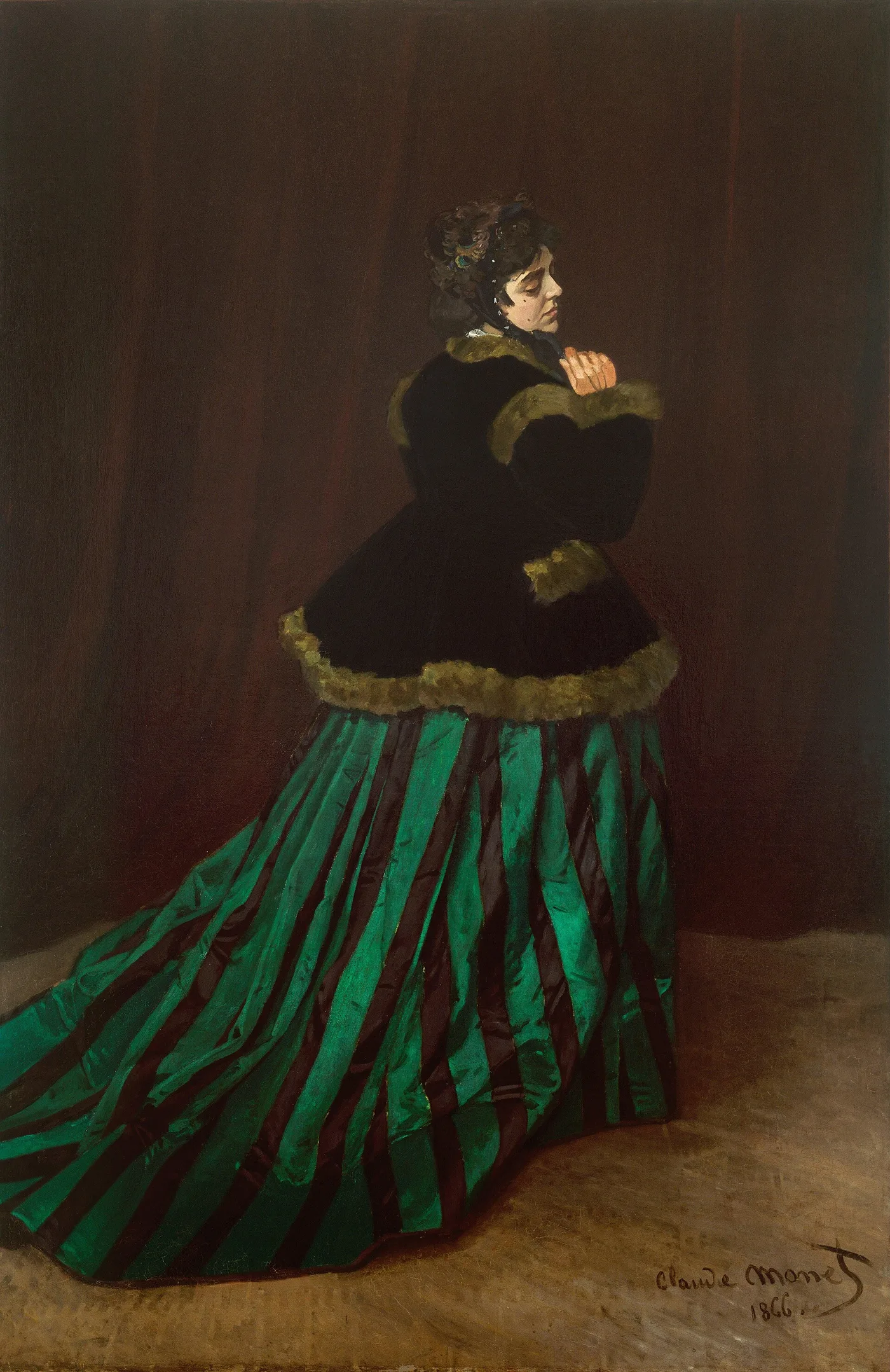
Image: Kunsthalle Bremen, via Wikimedia Commons.
- Date
- 1866
- Medium
- Oil on canvas
- Dimensions
- 231 x 151 cm (about 91 x 59 in.)
- Collection
- Kunsthalle Bremen, Der Kunstverein in Bremen, acquired 1906 with support from the Galerieverein (298-1906/1)
- Sitter
- Camille Doncieux, later Monet's wife
- Signed
- Lower right: Claude Monet 1866
- Exhibited
- Paris Salon of 1866
- Also known as
- Camille; The Woman in the Green Dress; Woman in a Green Dress; La Femme à la robe verte
What the painting shows
A young woman, seen at full length and life size, is caught in the act of turning away. Her back and the long train of her skirt face us, and she looks down and to one side, her head slightly turned, so that we never meet her eyes. She wears a silk dress with broad green and black stripes, a short black jacket trimmed with fur, yellow gloves and a dark bonnet with feathers. Behind her hangs a heavy curtain so dark a red that it reads as almost black.
The light falls softly from the left, as if from a window, and picks out the sheen of the silk. Monet makes the dress the real event of the picture: the folds of the skirt and the cropped train sweeping out of the frame at the bottom suggest movement, while the turned head creates a pause. The plain background keeps every bit of attention on the figure and her clothes.
A quick substitute for a bigger plan
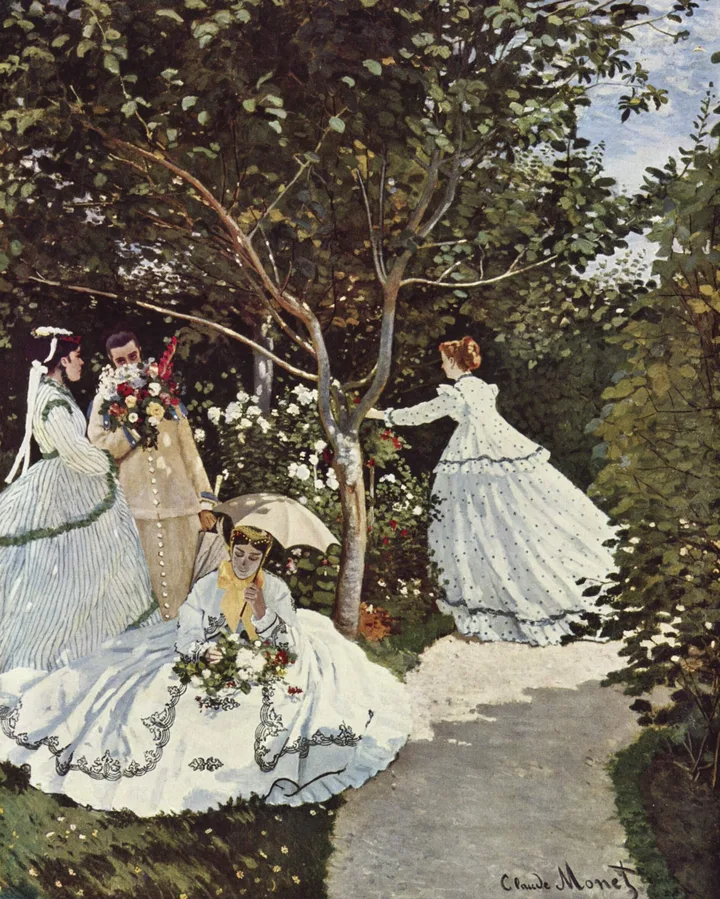
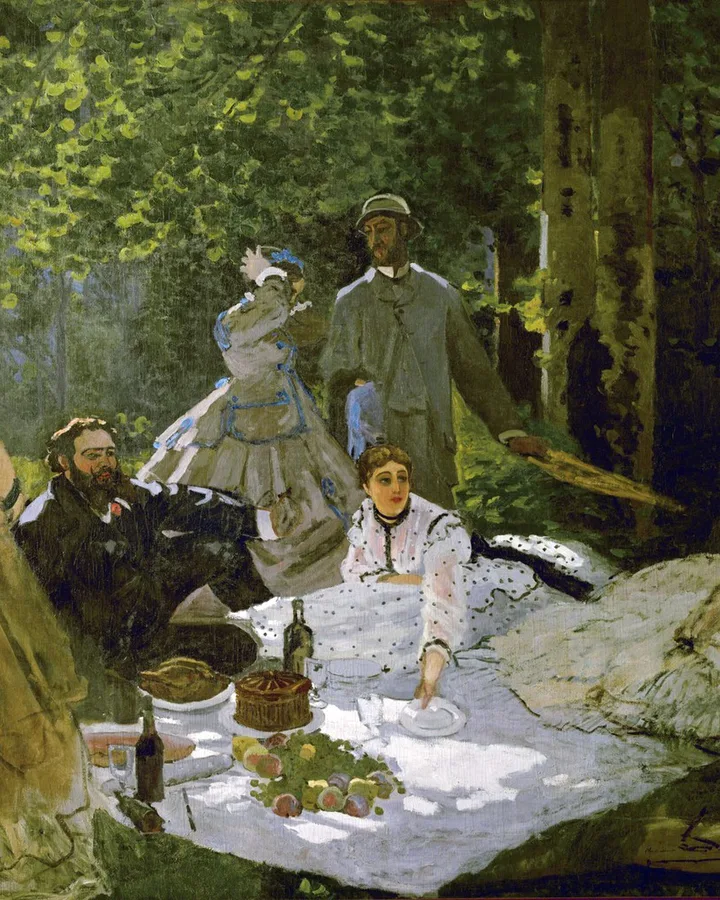
Monet's real ambition for the Salon of 1866 was Luncheon on the Grass, an enormous picnic scene more than four meters wide with life-size figures, meant as both a tribute to and a challenge to Édouard Manet's notorious painting of the same name. Camille was among the models who posed for it. Monet made many outdoor studies for it but could not finish in time. He later left the canvas with a landlord as security for unpaid rent; it was damaged by damp, and in 1884 he cut away the ruined parts. Two fragments survive in the Musée d'Orsay.
With the Salon deadline approaching, Monet instead painted Camille quickly as a single full-length figure. The format was a provocation in itself: life-size, full-length portraits had traditionally been reserved for royalty and the aristocracy. The pose and costume borrow from fashion illustrations and from carte-de-visite photographs, and Camille may have helped by supplying fashion prints and suggesting the pose.
Success at the Salon of 1866
The painting was accepted for the Salon and widely praised, the greatest success Monet ever had there. Émile Zola, who did not yet know Monet personally, singled it out in his Salon review for the newspaper L'Événement in May 1866. After a tiring walk through rooms of dull pictures, he wrote, this was the canvas that held his attention longest; he admired its energy and truth and said that although he had never met the painter, he felt like an old friend. Fourteen years later Zola still called it an excellent work.
The similarity of the names Monet and Manet caused confusion, and some visitors assumed the picture was by Manet, then the most controversial painter in Paris. A caricature of the painting played on the joke of "Monet or Manet?" The success had practical results too: it reassured Monet's family, and his aunt agreed to support him financially. Ironically, the Salon never again rewarded him in the same way.
Camille Doncieux and a portrait of fashion
Camille Doncieux was Monet's companion and model from the mid-1860s, and she later became his wife. Yet the Kunsthalle Bremen points out that the painting presents her less as an individual than as a type: the elegant Parisian woman of the day, defined by her clothes and bearing as much as by her face. That approach, borrowed from fashion plates and studio photographs, is typical of Monet's figure paintings, which rarely work as conventional portraits.
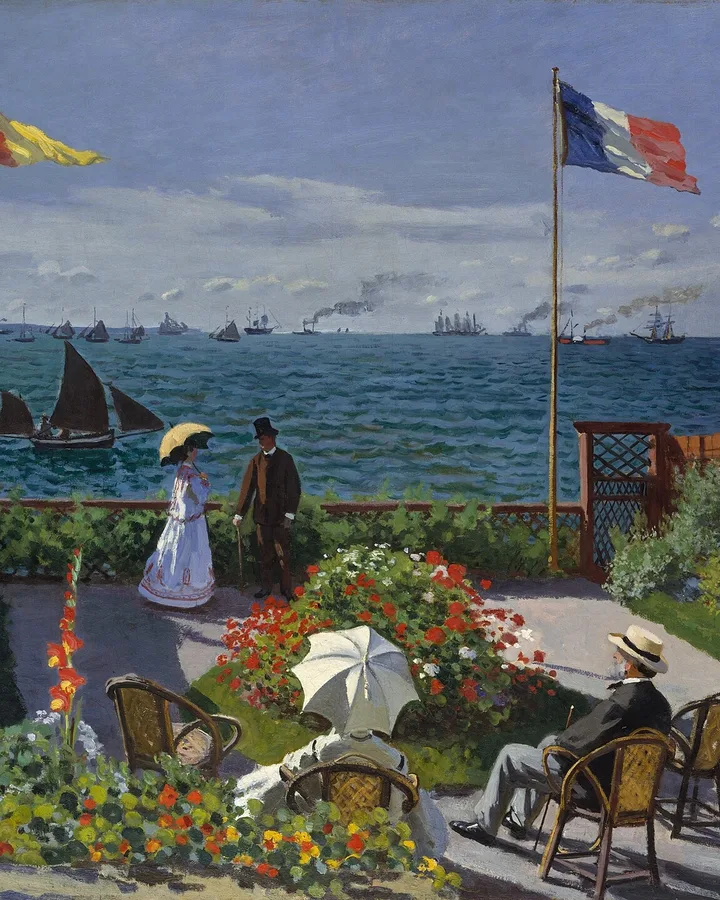
Camille went on to appear in many more of his pictures over the following decade. Their relationship drew disapproval from Monet's family, which caused friction in the summer of 1867, when he painted Garden at Sainte-Adresse with his relatives as models. Camille died in 1879. Camille, or The Woman in the Green Dress, remains the largest and most formal image Monet made of her, and the one that first brought his name to public attention.
In Bremen
The Kunsthalle Bremen acquired the painting in 1906 with support from its Galerieverein, a supporters' association, and it carries the inventory number 298-1906/1. The museum belongs to the Kunstverein in Bremen, the art association credited as the owner of the collection. Camille is one of the best-known works in its collection of French nineteenth-century painting.
The canvas is signed and dated in the lower right corner, Claude Monet 1866, and at 231 x 151 cm it is life-size. That scale is easy to forget when the picture is seen in reproduction, where it can look like a small, intimate portrait. In the gallery it is an imposing presence, much closer in size to the official full-length portraits of the period than to a domestic picture, which is exactly the effect Monet was aiming for when he sent it to the Salon.
What to look for
Spend time on the dress. The green and black stripes are not painted mechanically but bend and break as the silk folds, and the highlights on the satin are laid on in quick, confident strokes. This is the passage that impressed critics in 1866, and it shows how early Monet could make paint convey the texture and weight of fabric.
Notice how much of the canvas is given to the skirt and train, and how the hem is cut off by the lower edge, as if the figure is still moving out of the frame. Compare the treatment of the face, which is half-hidden and only lightly modeled, with the careful attention to the fur trim, gloves and bonnet. Finally, look at the dark curtain behind her. It is not empty but softly brushed, giving just enough depth to set off the green of the dress.
Frequently asked questions
Who is the woman in Monet's The Woman in the Green Dress?
She is Camille Doncieux, Monet's companion and favorite model, who later became his wife. She died in 1879.
Where is Camille (The Woman in the Green Dress)?
It is in the Kunsthalle Bremen in Germany, which acquired it in 1906 with support from its Galerieverein. Its inventory number is 298-1906/1.
Why did Monet paint Camille?
He could not finish his huge Luncheon on the Grass in time for the Salon of 1866, so he quickly painted this full-length portrait of Camille to submit instead. It was accepted and became his greatest Salon success.
How big is The Woman in the Green Dress?
It is life-size: 231 x 151 cm, or about 91 x 59 inches.