The Poppy Field near Argenteuil (1873)
A slope of red poppies runs down a summer field near Argenteuil, crossed by two pairs of figures, a woman with a sunshade and a child. Painted in 1873 and shown at the first Impressionist exhibition in 1874, Poppies hangs in the Musée d'Orsay, which calls it one of the world's most famous paintings.
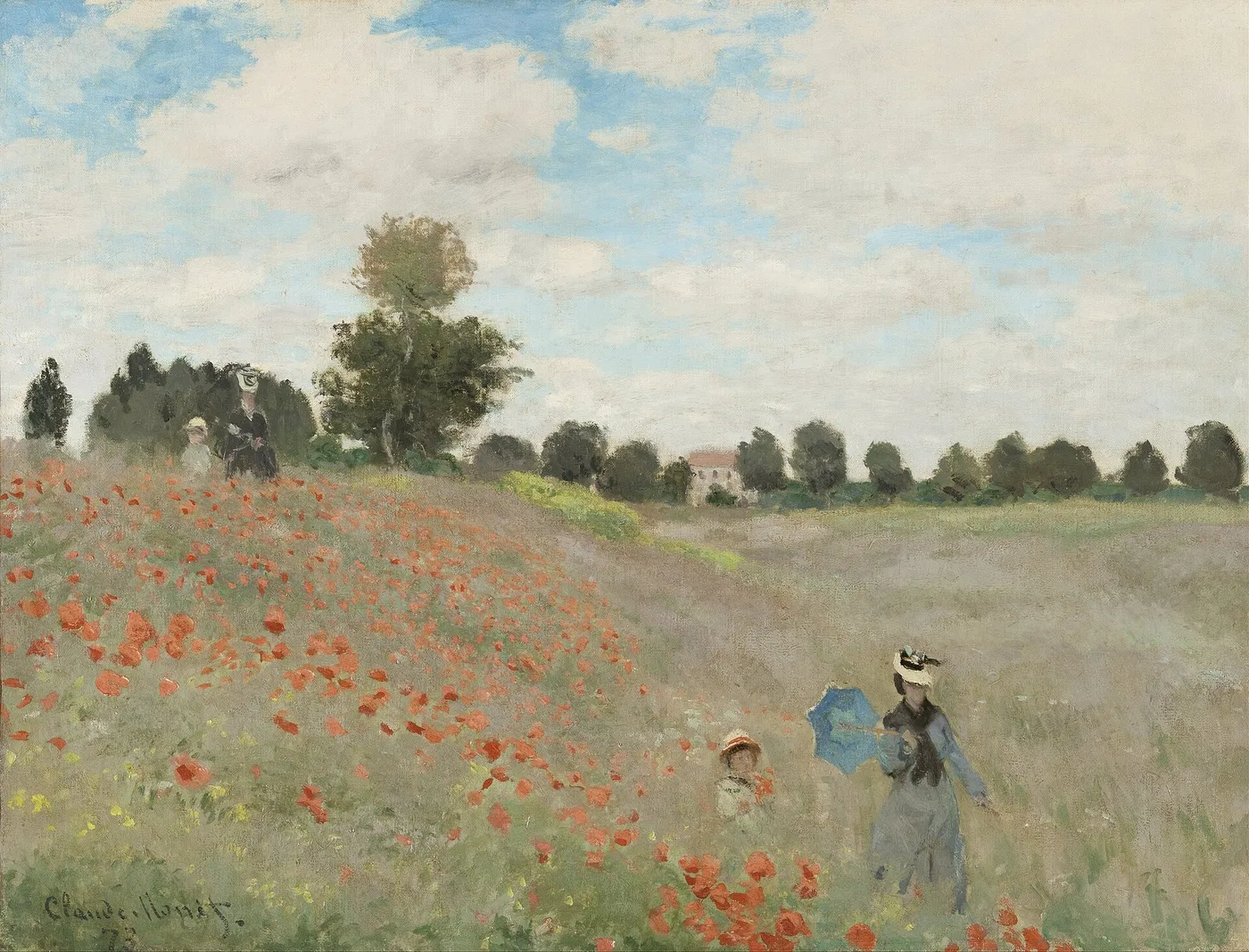
Image: Musée d'Orsay, via Wikimedia Commons.
- Date
- 1873 (signed and dated lower left "Claude Monet. 73")
- Medium
- Oil on canvas
- Dimensions
- 50 x 65.3 cm
- Location
- Fields near Argenteuil, northwest of Paris; the foreground figures are probably Camille and Jean Monet
- Collection
- Musée d'Orsay, Paris, RF 1676; gift of Étienne Moreau-Nélaton, 1906
- Also known as
- Poppies; Coquelicots; Poppy Field; Les Coquelicots; La promenade
What the painting shows
A grassy hillside slopes down from upper left to lower right under a wide, cloudy summer sky. The left side of the field is scattered with red poppies, painted as separate dabs of color that grow larger toward the bottom of the canvas. Along a diagonal through the field walk two pairs of figures. Near the top of the slope, a woman with a parasol and a child are partly hidden in the grass. In the foreground a second woman, holding a sunshade, walks with a small child in a straw hat. A line of trees and a single house close off the view.
The Musée d'Orsay notes that the woman with the sunshade and the child in the foreground are probably the artist's wife, Camille, and their son Jean, who was about six. The painting is not a portrait, though. The faces are just a few touches of paint.
Painted at Argenteuil
After returning from England in 1871, Monet settled in Argenteuil, a small town on the Seine a short train ride from Paris. The Musée d'Orsay describes the years he spent there, until 1878, as a time of fulfilment. His dealer, Paul Durand-Ruel, was buying his work, and the countryside around the town gave him open, bright landscapes in which to develop his painting out of doors.
Poppies belongs to that period. It is a small canvas, about 50 by 65 centimeters, easy to carry into a field and finish on the spot or close to it. The paint is laid on in quick, separate strokes, and many details, such as the figures and the house, are only suggested.
The painting seems to have gone to Durand-Ruel soon after it was made. The museum's provenance record places it in his gallery from 1873, probably acquired directly from the artist.
Shown at the first Impressionist exhibition
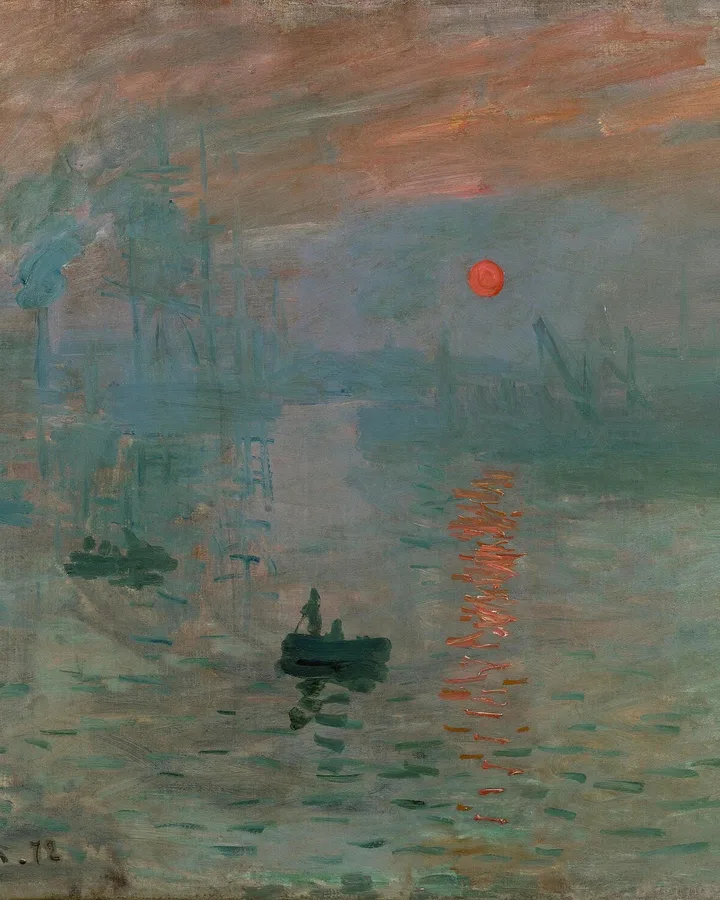
In April 1874 Monet showed Poppies at the first exhibition of the group that would become known as the Impressionists, held in the former studio of the photographer Nadar in Paris. It was number 95 in the catalogue. The same show included Impression, Sunrise, the painting that gave the movement its name.
After the exhibition the picture had a string of owners. According to the Musée d'Orsay, it passed from Durand-Ruel to the painter Ernest Duez and then to the singer Jean-Baptiste Faure, one of Monet's most important early collectors. Durand-Ruel bought it again in 1901, and in 1903 it was acquired by Étienne Moreau-Nélaton, a painter and collector. In 1906 he gave his collection to the French state, and with it this painting. It was shown at the Musée des Arts Décoratifs from 1907, moved to the Louvre in 1934 and to the Jeu de Paume in 1947, and was assigned to the new Musée d'Orsay in 1986.
Why it is so well known
The Musée d'Orsay calls Poppies one of the world's most famous paintings. Part of its appeal is simply the subject: a family walk through a field on a summer day, with no story to decode. It has been reproduced endlessly, and for many people it is the image that comes to mind when they think of Impressionism.
The painting is also a clear example of what made the group's work new in 1874. There is no carefully drawn foreground and no finished surface. Instead, Monet records the overall look of the scene, the red of the flowers against the green of the grass, the brightness of the sky, and leaves the viewer to assemble the rest.
The museum's commentary goes further, describing the oversized patches of red in the foreground as a sign of how much weight Monet gave to visual impression, and as a step toward abstraction.
What to look for
Look first at the poppies. Near the top of the hill they are tiny specks, but in the lower left corner they become broad blots of red, far larger than real flowers would appear. The change in size is what creates the sense of depth, since there are almost no other lines leading into the distance.
Then follow the figures. The Musée d'Orsay points out that the two pairs of mother and child are placed to mark a diagonal that runs from the top of the slope to the foreground. That line also divides the picture into two color zones: a warm area dominated by red on the left and a cooler, bluish green area on the right.
Finally, compare the sky with the field. The clouds are painted with soft, wide strokes in white, blue and pale gray, while the grass is broken into short touches. The contrast between the two textures keeps the field lively and the sky calm.
Frequently asked questions
Where is Monet's Poppies painting?
It is in the Musée d'Orsay in Paris, inventory number RF 1676. It came to the French state in 1906 as part of the gift of Étienne Moreau-Nélaton's collection.
Who are the people in Monet's Poppy Field?
The Musée d'Orsay says the woman with the sunshade and the child in the foreground are probably Monet's wife Camille and their son Jean. The second pair higher up the slope mainly serves to mark the diagonal of the composition.
When and where did Monet paint Poppies?
In 1873, near Argenteuil, the town on the Seine northwest of Paris where Monet lived after returning from England in 1871. The painting is signed and dated '73 at lower left.
Was Poppies in the first Impressionist exhibition?
Yes. Monet showed it at the 1874 exhibition in Nadar's former studio in Paris, where it was catalogue number 95.