Impression, Sunrise (1872)
A small orange sun rises over the harbor of Le Havre while rowboats drift across water that is barely distinguishable from the sky. Painted in 1872 and shown in Paris in 1874, Impression, Sunrise gave the Impressionist movement its name and is the best-known work in the Musée Marmottan Monet.
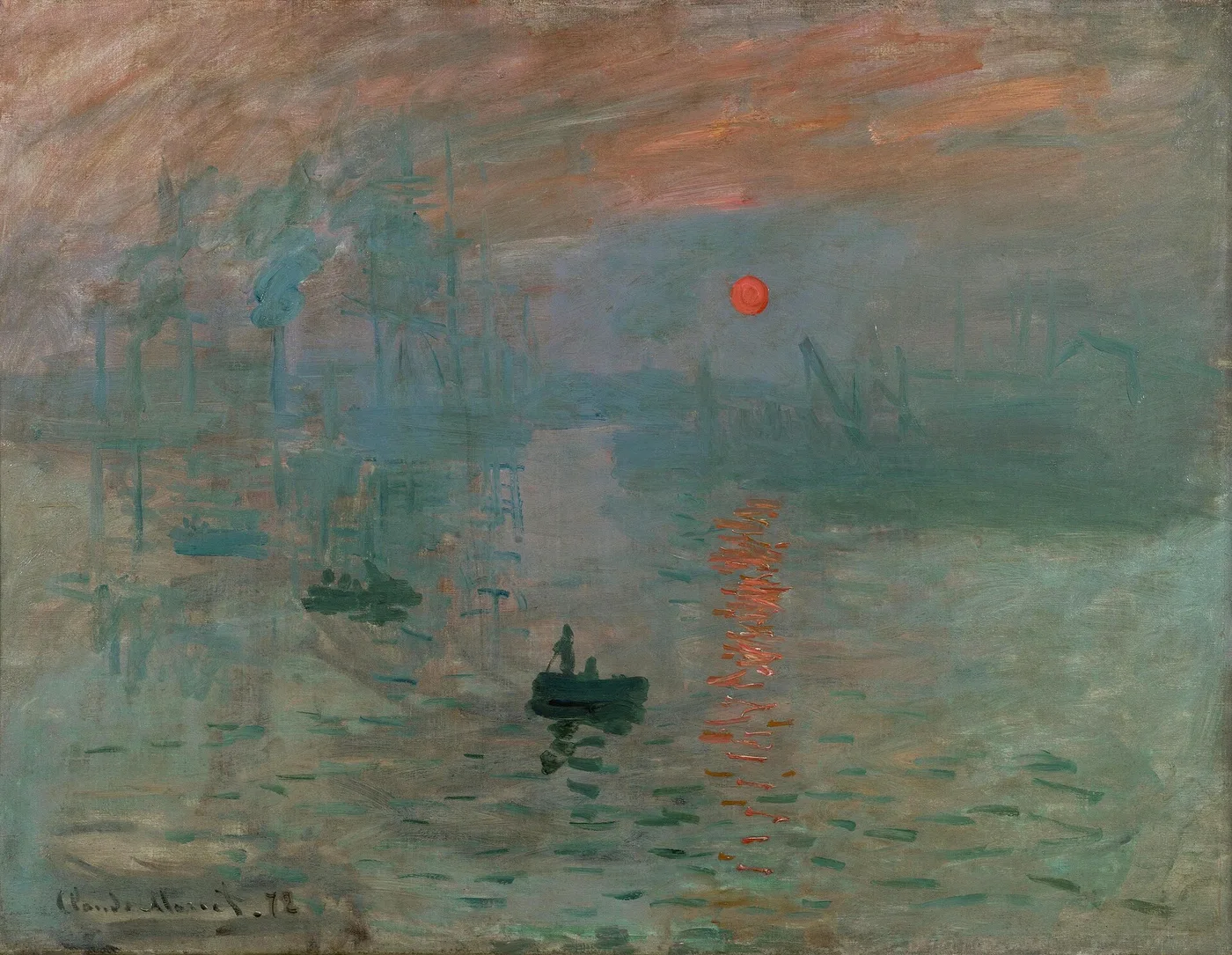
Image: Musée Marmottan Monet, via Wikimedia Commons.
- Date
- 1872 (signed lower left "Claude Monet"; the date "72" was added later)
- Medium
- Oil on canvas
- Dimensions
- 50 x 65 cm (unframed, per the Musée Marmottan Monet)
- Location
- The outer harbor of Le Havre, Normandy, seen at dawn from the Hôtel de l'Amirauté
- Collection
- Musée Marmottan Monet, Paris, inv. 4014; gift of Eugène and Victorine Donop de Monchy, 1940
- Also known as
- Impression, soleil levant; Impression Sunrise (1872); Monet sunrise painting
What the painting shows
The picture looks across the port of Le Havre, the Normandy town where Monet grew up, in the first minutes after sunrise. Mist softens everything. On the horizon, cranes, smokestacks and the masts of ships are reduced to faint gray-blue shapes. In the foreground, two or three small rowboats appear as dark silhouettes, with a figure standing in the nearest one. Above them hangs a flat disc of orange sun, and its reflection runs down the water in short, broken strokes of the same color.
The Musée Marmottan Monet describes the view as looking southeast over the outer harbor, framed by two quays, with the central opening marking a lock that let large transatlantic ships enter at high tide. Very little is drawn in detail. The sky and the water are painted in thin, fluid washes of blue, gray and orange, and the brushwork is visible everywhere. According to the museum, the rowboats and the sun were the last elements Monet added.
Where and when it was painted
Monet returned to Le Havre in 1872 and painted a group of views of the port at different times of day. The Marmottan states that he worked from his room at the Hôtel de l'Amirauté, looking out over the harbor, and that the canvas was painted in just a few hours.
The exact morning has been worked out. In 2014, for an exhibition at the Marmottan devoted to the painting, the astronomer Donald Olson and his colleagues compared the position of the sun, tide tables, weather records and the direction of the smoke plumes in the picture with the view from the hotel. They concluded that Monet painted it on 13 November 1872, at about 7:35 in the morning. The same research confirmed that the scene is a sunrise. The painting had sometimes been described as a sunset.
The picture is signed at lower left. The museum notes that the date "72" next to the signature was added later.
The 1874 exhibition and the name Impressionism
In April 1874 a group of independent artists, with Monet, Degas, Pissarro, Renoir and Sisley at its core, opened their own exhibition in the former studio of the photographer Nadar in Paris. About thirty artists showed more than 200 works, outside the official Salon, under the banner of the Société anonyme des artistes peintres, sculpteurs, graveurs et lithographes.
When the catalogue was being prepared, Monet was asked for a title. He later explained that the view could not really pass as a view of Le Havre, so he answered "put Impression". The painting was listed as Impression, soleil levant.
On 25 April 1874, the critic Louis Leroy published a mocking review in the satirical paper Le Charivari, written as a conversation between two visitors. He seized on the word in Monet's title and called the exhibitors Impressionists. The label was meant as a joke, but the artists soon adopted it themselves, and it became the name of the movement.
Owners, theft and recovery
The painting did not stay with Monet for long. In May 1874 the collector Ernest Hoschedé bought it for 800 francs. In 1878 his collection was sold at a court-ordered auction in Paris, and the canvas fetched only 210 francs. It was acquired by Georges de Bellio, a doctor and an early supporter of the Impressionists. It passed to his daughter Victorine and her husband, Eugène Donop de Monchy, who gave it to the Musée Marmottan; the museum records the acquisition on 23 May 1940. During the Second World War it was stored for safety at the Château de Chambord.
In 1985 armed thieves stole Impression, Sunrise from the Marmottan. It was recovered in Corsica in 1990 and went back on display in 1991. In 2024, 150 years after the first Impressionist exhibition, the museum lent it to the Musée d'Orsay in Paris and then to the National Gallery of Art in Washington.
What to look for
Stand back first, then look at the sun. It seems to glow, yet scientists who measured the painting found that the orange disc has almost the same luminance, or brightness, as the gray sky around it. In a black-and-white reproduction the sun nearly disappears. The neuroscientist Margaret Livingstone has linked this to the way the brain handles color and brightness separately: the older part of the visual system, which registers only brightness, can barely tell the sun from the sky. That may be why the sun seems to shimmer when you look at it.
Next, follow the reflection. It is built from a handful of separate horizontal strokes rather than a smooth band, and each one is a single movement of the brush. Notice also how much of the harbor is left vague. Ships and cranes are suggested with a few marks, and the line between sea and sky dissolves. That economy is the point of the title: the canvas records the look of a moment, not an inventory of the port.
Frequently asked questions
Where is Impression, Sunrise now?
It is in the Musée Marmottan Monet in Paris, inventory number 4014. The museum received it in 1940 from Eugène and Victorine Donop de Monchy, the son-in-law and daughter of the collector Georges de Bellio.
Why is it called Impression, Sunrise?
Monet gave it the title for the 1874 exhibition catalogue because, as he later said, the picture could not really pass as a view of Le Havre. The critic Louis Leroy used the word to mock the group as Impressionists, and the name stuck.
Is Impression, Sunrise a sunrise or a sunset?
A sunrise. Research published for a 2014 exhibition at the Marmottan, using the sun's position, tides and weather records, concluded that Monet painted it on the morning of 13 November 1872, at about 7:35 a.m.
How big is Impression, Sunrise?
It is a fairly small canvas. The Musée Marmottan Monet gives the unframed size as 50 x 65 cm, roughly 20 x 26 inches.