Famous Monet Paintings
A handful of Claude Monet's paintings are known far beyond museum walls: the harbour at dawn that gave Impressionism its name, his wife Camille with a parasol on a windy hill, the poppy field at Argenteuil, the footbridge over his water garden at Giverny.
The pages below tell how each of these paintings was made, what happened to it afterwards and where it hangs today, drawing on the museums' own records and published research. The images are public-domain reproductions from Wikimedia Commons.
For everything else, browse the full archive or start with a series such as the Water Lilies.
-
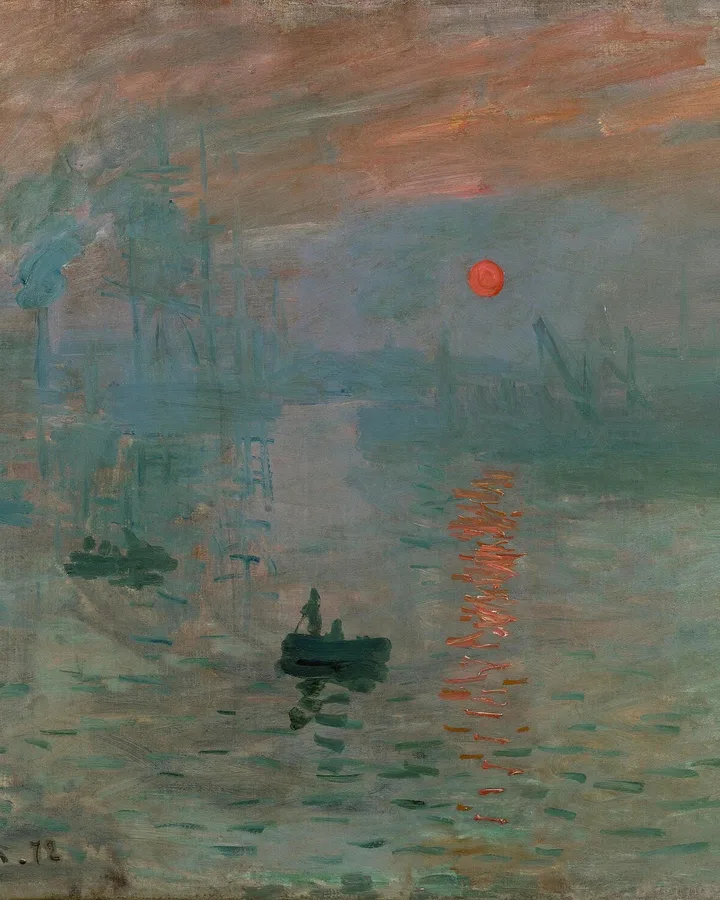
Impression, Sunrise (1872)
A small orange sun rises over the harbor of Le Havre while rowboats drift across water that is barely distinguishable from the sky. Painted in 1872 and shown in Paris in 1874, Impression, Sunrise gave the Impressionist movement its name and is the best-known work in the Musée Marmottan Monet.
The story behind it → -
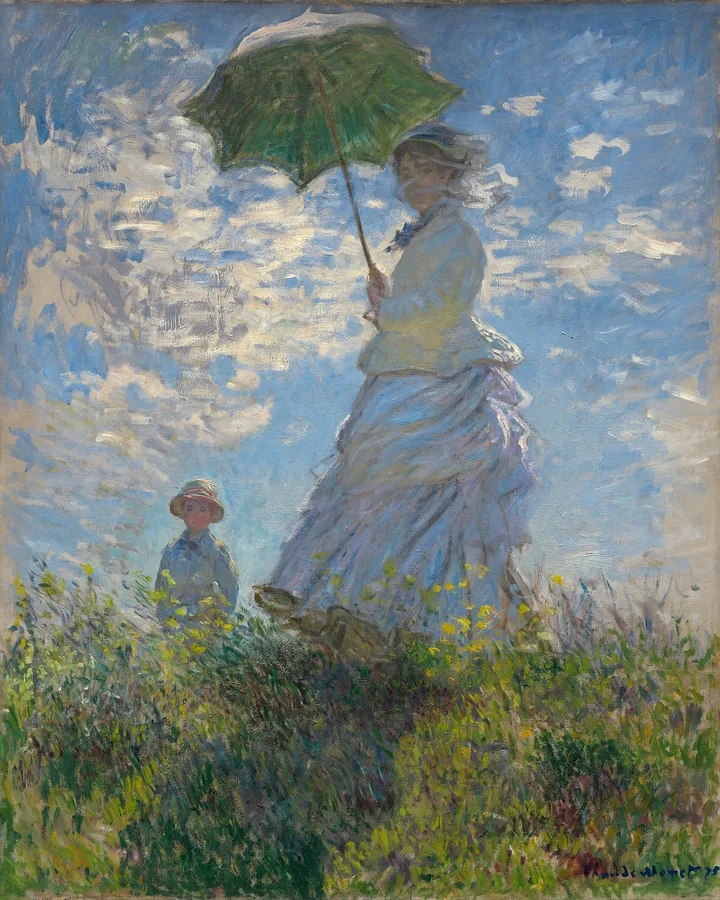
Woman with a Parasol - Madame Monet and Her Son (1875)
Camille Monet stands on a grassy rise against a bright, windy sky, holding a green parasol, while the couple's son Jean looks out from behind the slope. Painted outdoors at Argenteuil in 1875, it is one of Monet's best-known figure paintings and hangs in the National Gallery of Art in Washington.
The story behind it → -
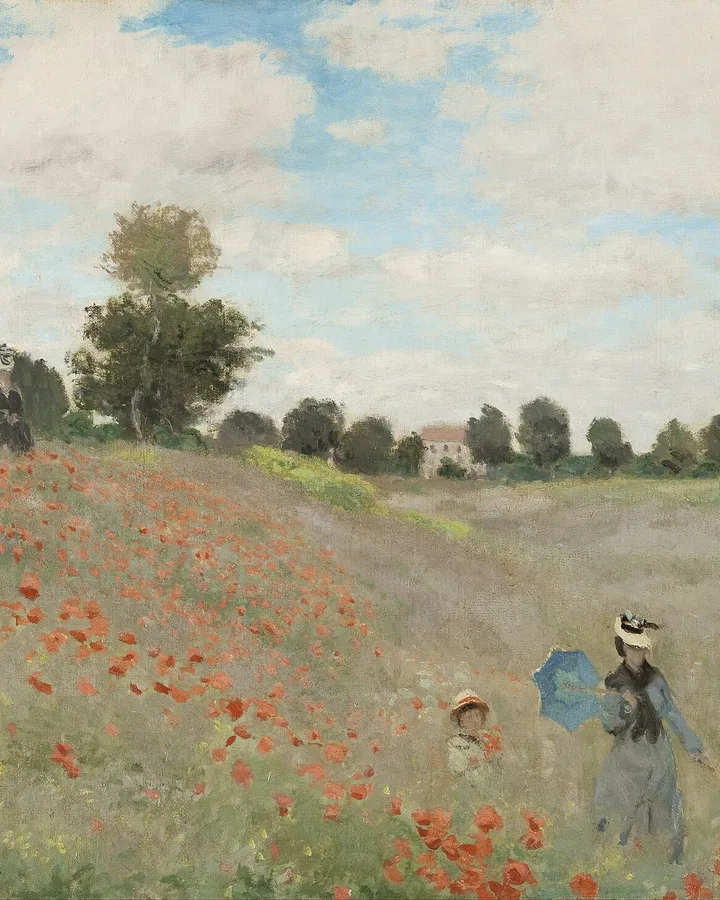
The Poppy Field near Argenteuil (1873)
A slope of red poppies runs down a summer field near Argenteuil, crossed by two pairs of figures, a woman with a sunshade and a child. Painted in 1873 and shown at the first Impressionist exhibition in 1874, Poppies hangs in the Musée d'Orsay, which calls it one of the world's most famous paintings.
The story behind it → -
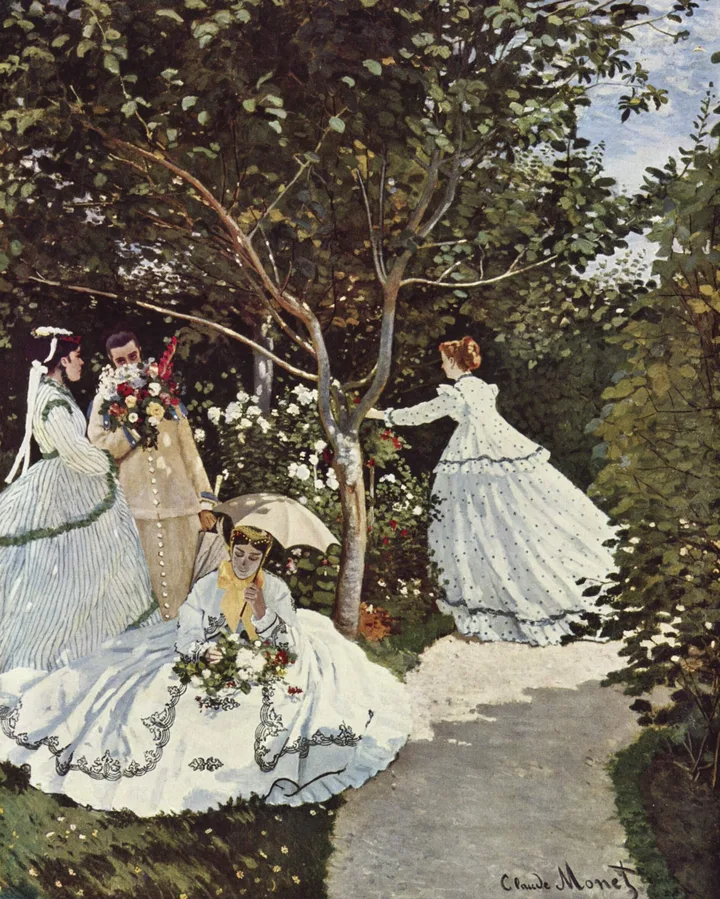
Women in the Garden (about 1866)
Four women in light summer dresses gather flowers in a sunlit garden, with sunlight and shadow falling across their clothes and the path. Begun outdoors in 1866 on a canvas more than two and a half meters tall, Women in the Garden was rejected by the Salon of 1867 and is now in the Musée d'Orsay.
The story behind it → -
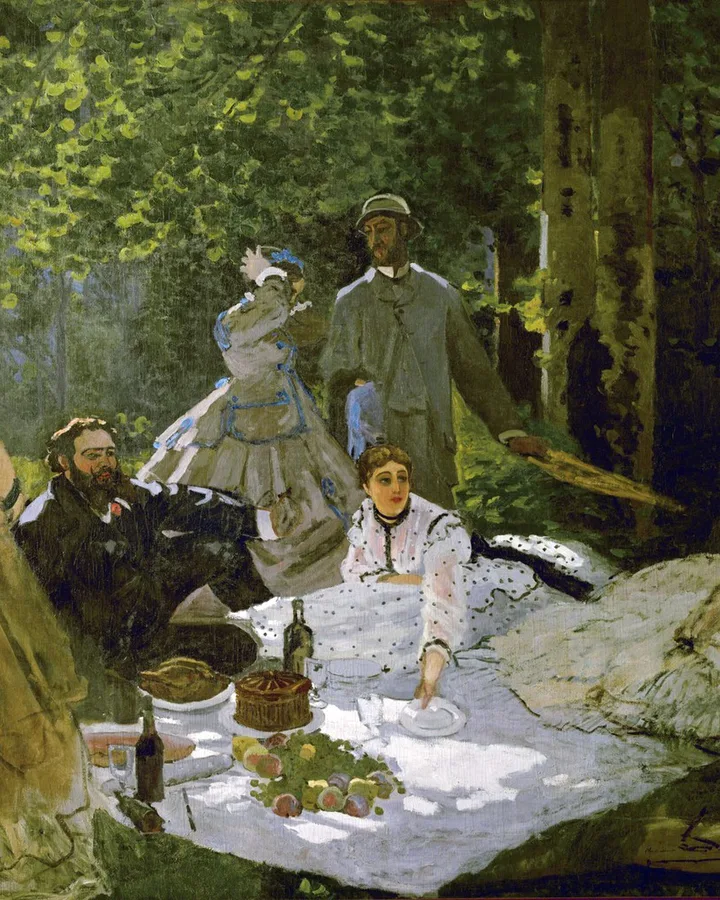
Luncheon on the Grass (1865-1866)
A party of fashionably dressed Parisians picnics in a forest clearing, sunlight filtering through the leaves onto a white cloth spread with food and wine. Monet began this huge canvas in 1865 to rival Manet, never finished it, and later cut it up after it was damaged by damp. Two fragments survive in the Musée d'Orsay.
The story behind it → -
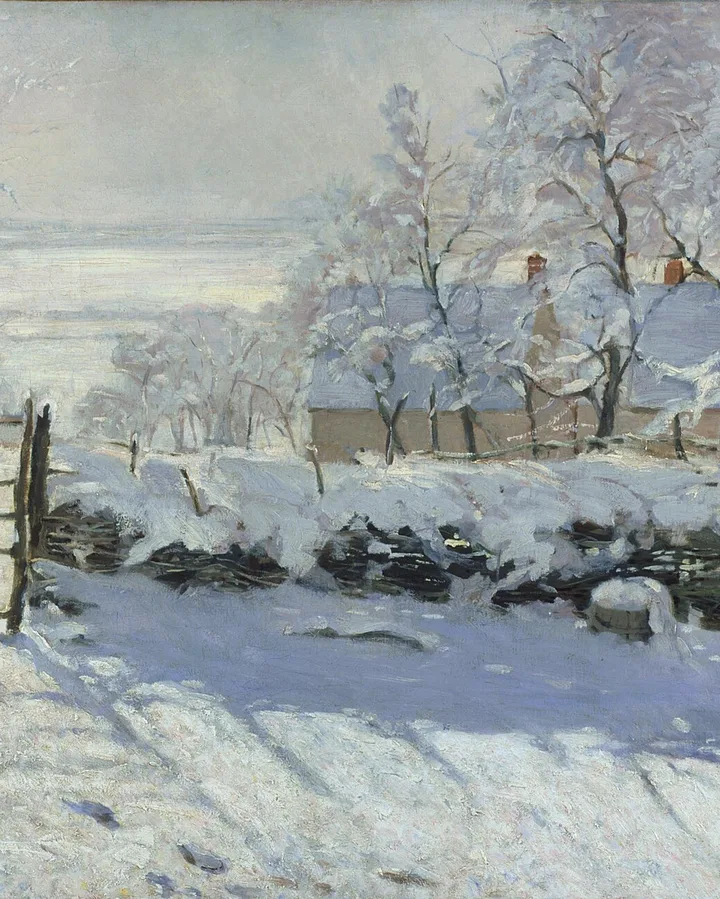
The Magpie (1868-1869)
A single black magpie perches on a wooden gate in a snow-covered field, while low winter sun throws blue-violet shadows across the snow. Painted near Étretat in the winter of 1868-69 and rejected by the Salon of 1869, The Magpie is Monet's largest snow scene and one of the best-loved paintings in the Musée d'Orsay.
The story behind it → -
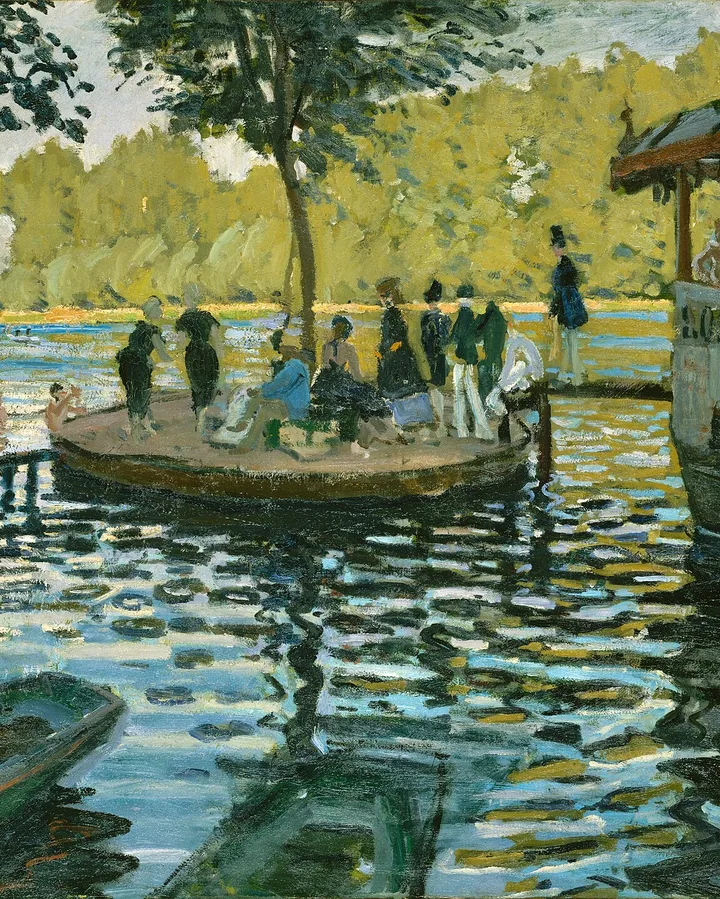
La Grenouillère (1869)
Bathers, rowing boats and a tiny tree-topped island crowded with visitors at a popular resort on the Seine west of Paris. Monet painted La Grenouillère in the summer of 1869 while working side by side with Renoir, and its quick, broken brushwork is one of the clearest early signs of the style that would become Impressionism. The painting is in the Metropolitan Museum of Art, New York.
The story behind it → -
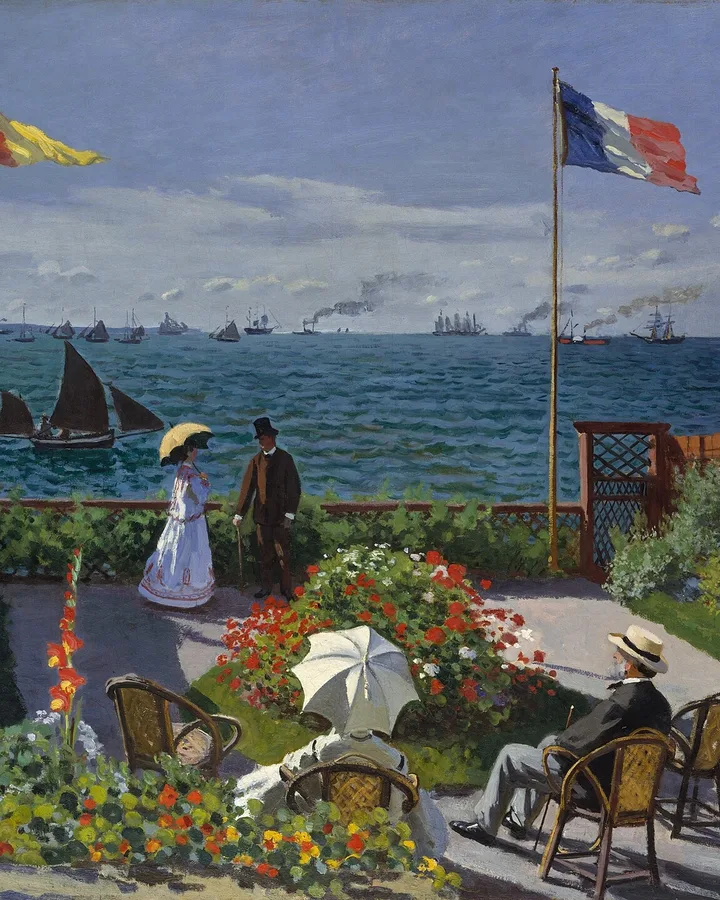
Garden at Sainte-Adresse (1867)
A sunlit terrace above the English Channel, with flowerbeds, two flags snapping in the wind and members of Monet's family taking the air. Painted in the summer of 1867 at Sainte-Adresse near Le Havre, it divides land, sea and sky into three flat bands of color, a bold idea Monet drew partly from Japanese prints. It has been in the Metropolitan Museum of Art since 1967.
The story behind it → -
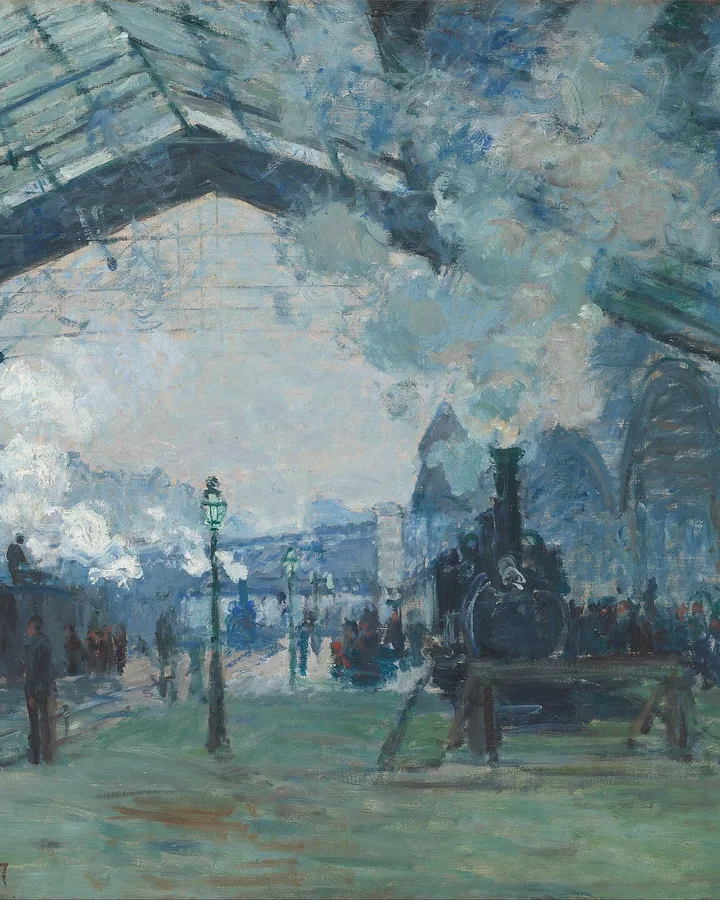
Arrival of the Normandy Train, Gare Saint-Lazare (1877)
A locomotive pulls into the great iron-and-glass train shed of the Gare Saint-Lazare in Paris, its steam rising into the roof. Monet painted twelve views of the station in early 1877 and showed seven of them at the third Impressionist exhibition that April. This version, Arrival of the Normandy Train, is in the Art Institute of Chicago; the best-known other version is in the Musée d'Orsay, Paris.
The story behind it → -
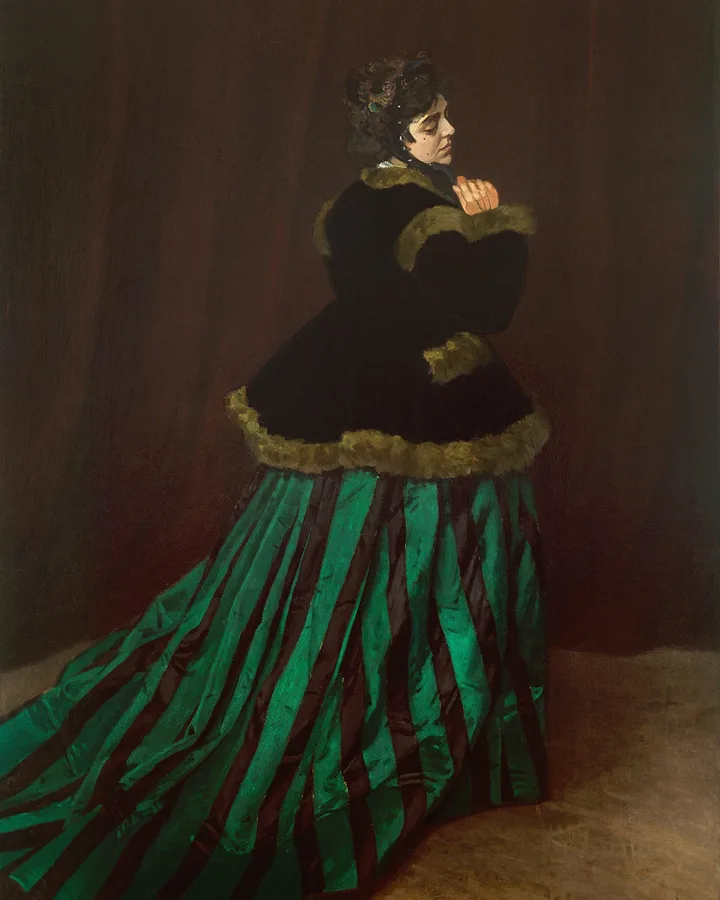
Camille (The Woman in the Green Dress) (1866)
A life-size portrait of Camille Doncieux, Monet's future wife, turning away in a sweeping green-and-black striped silk dress. Monet painted it quickly in early 1866 when his huge Luncheon on the Grass could not be finished in time for the Paris Salon, and it became the biggest Salon success of his career. It has been in the Kunsthalle Bremen, Germany, since 1906.
The story behind it → -
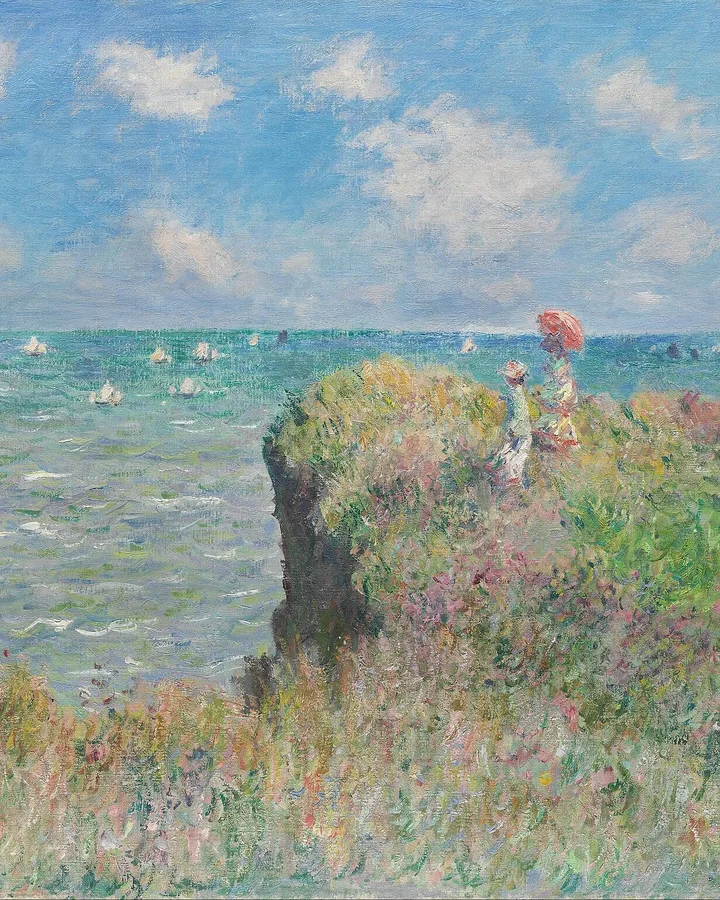
The Cliff Walk at Pourville (1882)
Two women stand on a grassy cliff top in the wind, looking out over a bright blue Channel scattered with sailing boats. Monet painted it in 1882 near Pourville, on the Normandy coast west of Dieppe, during a year in which he made nearly a hundred coastal pictures. It is in the Art Institute of Chicago.
The story behind it → -
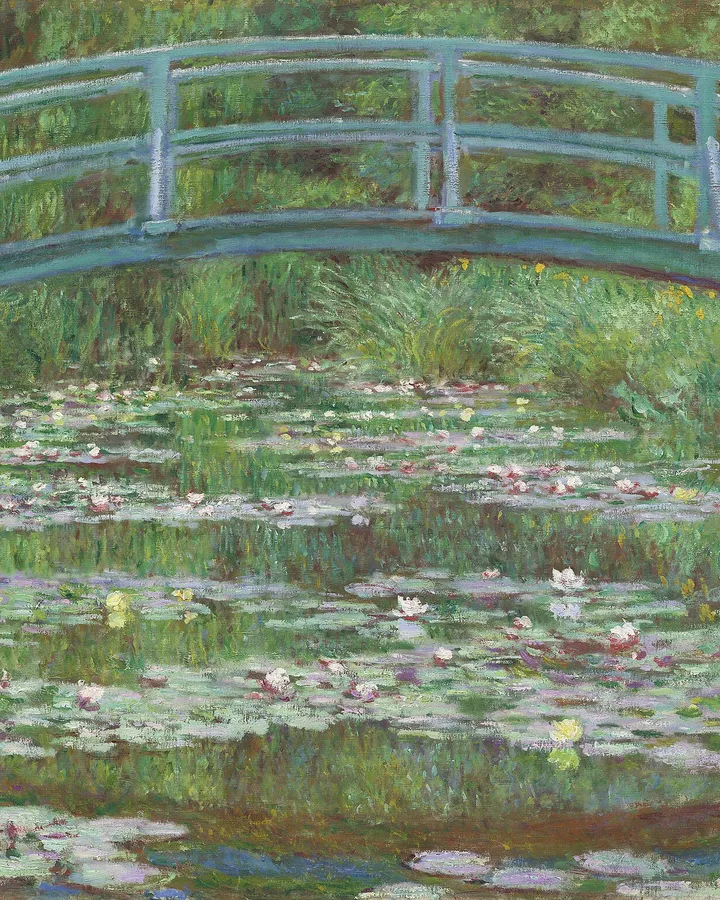
The Japanese Footbridge (1899)
An arched wooden footbridge crosses Monet's water lily pond at Giverny, framed by dense green foliage and floating lily pads. This canvas, now in the National Gallery of Art in Washington, is one of twelve views of the bridge and pond that Monet painted in the summer of 1899. He returned to the bridge for the rest of his life, ending with near-abstract versions painted around 1920.
The story behind it →