Garden at Sainte-Adresse (1867)
A sunlit terrace above the English Channel, with flowerbeds, two flags snapping in the wind and members of Monet's family taking the air. Painted in the summer of 1867 at Sainte-Adresse near Le Havre, it divides land, sea and sky into three flat bands of color, a bold idea Monet drew partly from Japanese prints. It has been in the Metropolitan Museum of Art since 1967.
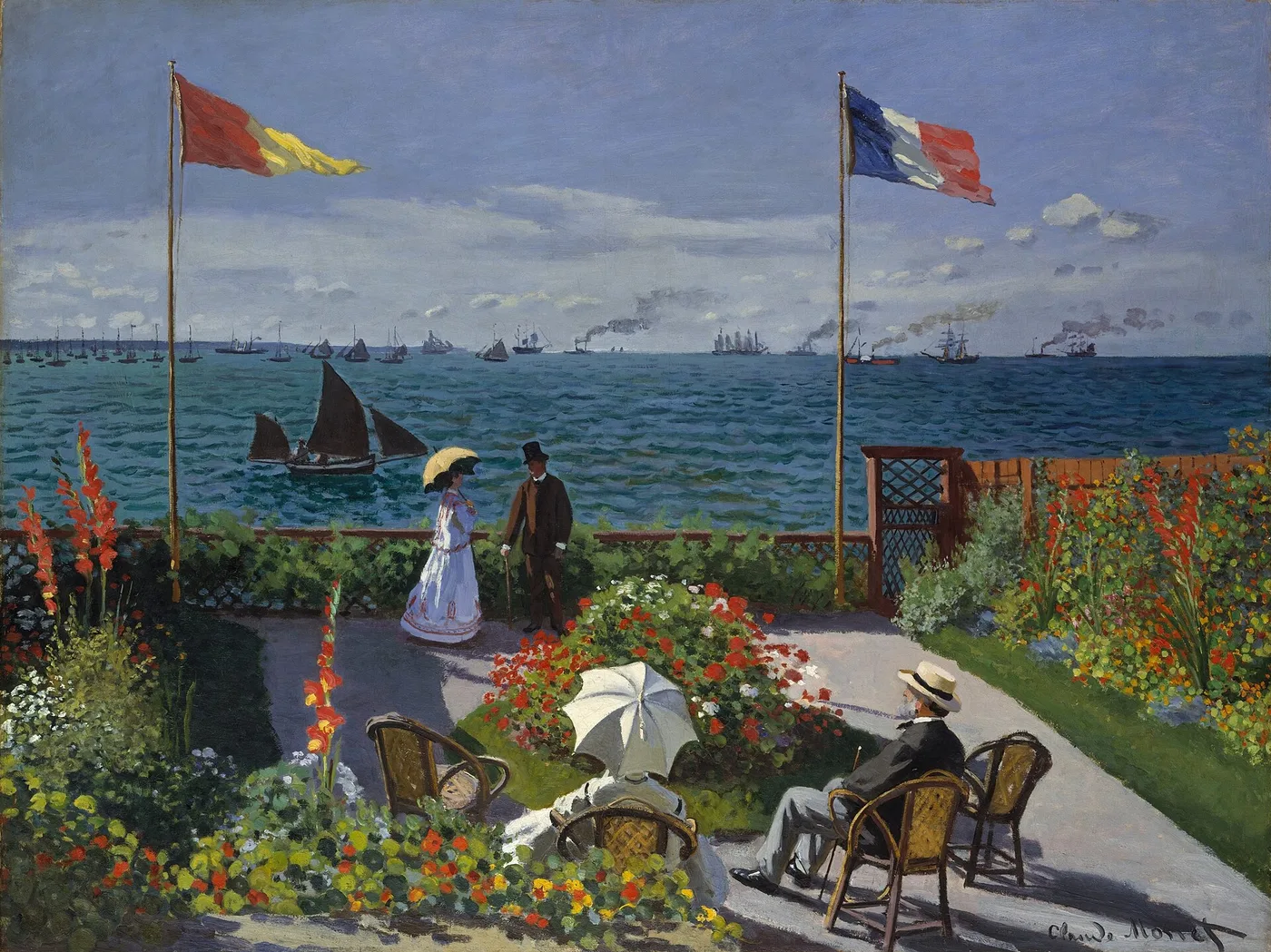
Image: Metropolitan Museum of Art, via Wikimedia Commons.
- Date
- 1867
- Medium
- Oil on canvas
- Dimensions
- 38 5/8 x 51 1/8 in. (98.1 x 129.9 cm)
- Collection
- The Metropolitan Museum of Art, New York, Purchase, special contributions and funds given or bequeathed by friends of the Museum, 1967 (67.241)
- Location
- Sainte-Adresse, a seaside resort next to Le Havre, Normandy, looking across the Seine estuary toward Honfleur
- Sitters
- Probably the artist's father, Adolphe Monet, and other relatives
- Also known as
- Jardin à Sainte-Adresse; Terrace at Sainte-Adresse; La terrasse à Sainte-Adresse
What the painting shows
We look down from a raised point onto a garden terrace at the edge of the sea. The foreground is a bright bed of red and white flowers. Two tall flagpoles rise from the terrace, one flying the French tricolor, their flags pulled straight by a stiff breeze. In the middle ground a man in a panama hat sits in a cane chair with his back half turned to us, beside a woman shaded by a parasol. Farther off, a young woman with a parasol stands at the fence talking with a man.
Beyond the fence the Channel is crowded with traffic: sailing boats, fishing craft and steamships trailing smoke. On the horizon is the coast across the estuary at Honfleur. Above everything is a pale sky with drifting clouds. Everything is sharp and brightly lit, and the whole scene reads as an image of comfortable modern leisure on a summer's day.
A family summer at Sainte-Adresse
Monet grew up in Le Havre, and in the summer of 1867 he stayed with his family at Sainte-Adresse, a seaside resort on the city's edge. He used relatives as models. The seated man in the panama hat is probably his father, Adolphe Monet. The other figures are thought to include Jeanne-Marguerite Lecadre, the wife of Monet's cousin, her father and possibly her sister Sophie.
The cheerful picture hides a tense summer. Monet's family disapproved of his relationship with Camille Doncieux, the young woman who had modeled for him in Paris and who later became his wife, and relations with his father were strained. Monet was also short of money and dependent on his family's help. Scholars therefore caution against reading the painting as a straightforward family portrait. It is better understood as a carefully staged image of bourgeois leisure, set in a place Monet knew well.
Three bands of color and Japanese prints
What made the picture unusual in 1867 is its structure. Monet chose a high viewpoint and divided the canvas into three horizontal zones of nearly equal weight: the terrace, the sea and the sky. Each is painted in intense, bright color, and there is little of the gradual recession into depth that academic landscape painting expected. The effect is to flatten the picture, so that we are always aware of the painted surface as much as the view.
The Met connects this approach to Monet's admiration for Japanese woodblock prints, which he and his circle collected. Monet himself later called the work his "Chinese painting" with flags, and Renoir described it as a "Japanese" painting. A print by Hokusai, Turban-shell Hall of the Five-Hundred-Rakan Temple, with figures on a terrace looking out over a wide view, has been suggested as a possible model; Monet owned a copy, and it still hangs in his house at Giverny.
Exhibition and reputation
Monet did not show the painting right away. Twelve years later he lent it to the fourth Impressionist exhibition in Paris, held from April 10 to May 11, 1879, where it was listed as number 157, Jardin à Sainte-Adresse. By then the bright, flat handling that had seemed daring in 1867 sat comfortably among the work of the Impressionist group.
Today the painting is often used to show how early Monet's characteristic interests were in place. Five years before Impression, Sunrise, he was already painting outdoor light at full strength, organizing a scene as broad areas of color and choosing a modern subject: middle-class people relaxing by the sea, with steamships on the horizon. The tension between a convincing view and an insistently flat surface remained central to his work for the rest of his life, all the way to the late water lily paintings.
The 1967 sale
Before 1967 the painting belonged to the Reverend Theodore Pitcairn of Bryn Athyn, Pennsylvania, and the Beneficia Foundation. It was offered at Christie's in London on December 1, 1967, under the French title La terrasse à Sainte-Adresse, and sold for £588,000. Christie's still lists the sale among the most notable Impressionist paintings it has handled.
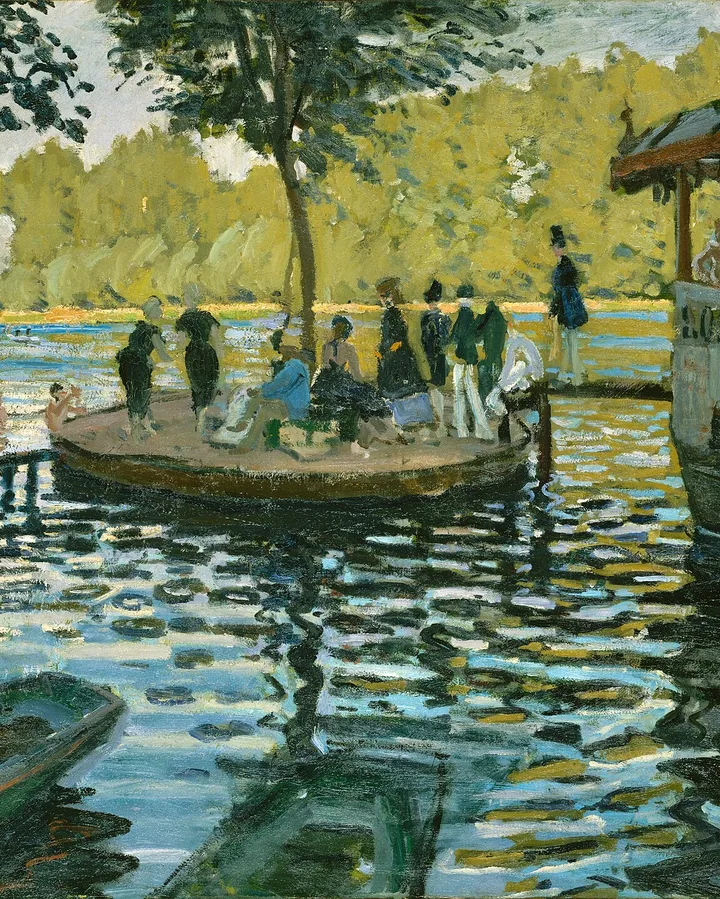
The Metropolitan Museum acquired the picture after the sale, paying for it with special contributions and funds given or bequeathed by friends of the museum. The English title the museum uses, Garden at Sainte-Adresse, follows the 1879 exhibition title, but the alternate name Terrace at Sainte-Adresse, from the sale, is still widely used. The painting hangs in the Met's galleries of nineteenth-century European painting, near La Grenouillère.
What to look for
Start with the flags. They are almost the only diagonal and vertical accents in a picture built from horizontals, and their crisp, snapping shapes tell you how strong the wind is. Then compare the three bands: the dense, textured strokes of the flowerbed, the flatter blues and greens of the sea, and the thin, airy sky.
Look at how the figures are placed. None of them looks at us or at each other in any obvious way, and they are spaced out across the terrace almost like pieces on a board. Their shadows fall sharply on the gravel, which helps fix the time as a bright midday. Out at sea, notice the mix of old and new: sailing boats beside smoking steamships, a reminder that Le Havre was one of France's busiest modern ports. Finally, check the horizon, which sits high, so that the sea seems to rise up behind the terrace rather than recede.
Frequently asked questions
Where is Garden at Sainte-Adresse?
It is in the Metropolitan Museum of Art in New York, accession number 67.241. The museum acquired it in 1967 with special contributions and funds given or bequeathed by friends of the museum.
Who are the people in Garden at Sainte-Adresse?
Monet used relatives as models. The seated man in the panama hat is probably his father, Adolphe Monet. The others are thought to include his cousin's wife Jeanne-Marguerite Lecadre, her father and possibly her sister Sophie.
Where is Sainte-Adresse?
Sainte-Adresse is a seaside resort on the edge of Le Havre in Normandy, where Monet grew up. From the terrace in the painting you look across the mouth of the Seine toward Honfleur.
How much did Garden at Sainte-Adresse sell for?
It was sold at Christie's in London on December 1, 1967, for £588,000, and the Metropolitan Museum acquired it after the sale.