La Grenouillère (1869)
Bathers, rowing boats and a tiny tree-topped island crowded with visitors at a popular resort on the Seine west of Paris. Monet painted La Grenouillère in the summer of 1869 while working side by side with Renoir, and its quick, broken brushwork is one of the clearest early signs of the style that would become Impressionism. The painting is in the Metropolitan Museum of Art, New York.
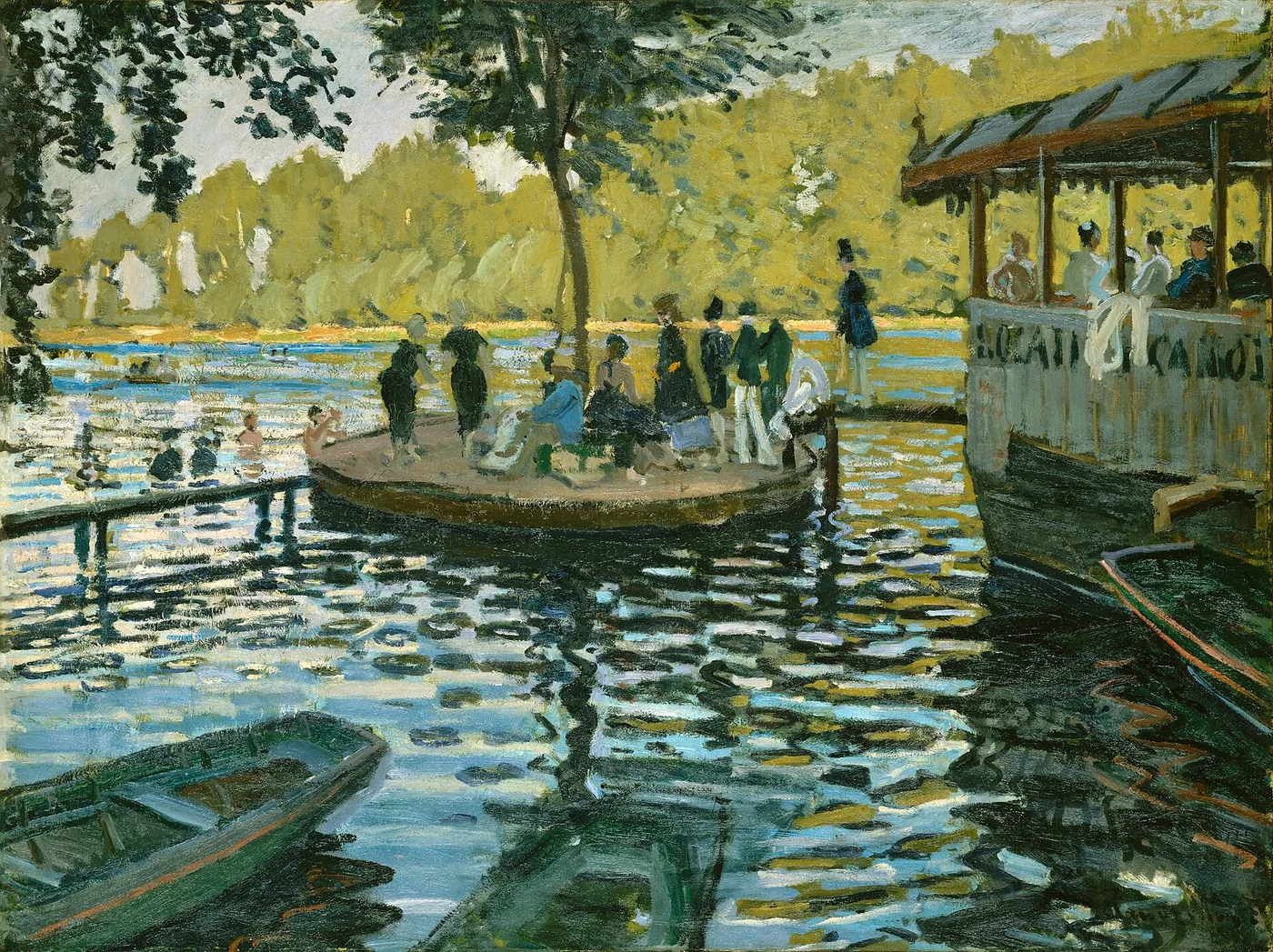
Image: Metropolitan Museum of Art, via Wikimedia Commons.
- Date
- 1869
- Medium
- Oil on canvas
- Dimensions
- 29 3/8 x 39 1/4 in. (74.6 x 99.7 cm)
- Collection
- The Metropolitan Museum of Art, New York, H. O. Havemeyer Collection, Bequest of Mrs. H. O. Havemeyer, 1929 (29.100.112)
- Location
- La Grenouillère, a bathing and boating resort on the Seine near Croissy-sur-Seine and Bougival, west of Paris
- Also known as
- La Grenouillère (1869); Bain à la Grenouillère; The Frog Pond
What the painting shows
The center of the picture is a small round island with a single tree, nicknamed the Camembert (it was also called the Flowerpot), packed with day-trippers in summer clothes. A narrow gangplank runs from the island to the right, toward the floating café and boat-hire establishment that gave the resort its name. To the left, bathers stand waist-deep in the river. In the foreground a row of hired rowing boats sits on the water, their hulls drawn with a few dark strokes.
The real subject is the light on the river. Monet built the water from short, broad horizontal strokes of blue, green, white and near-black, laid side by side without blending, so that the surface seems to move. The figures are summarized just as quickly: a dab of color for a head, a stroke for a dress. The trees across the background are left loose and partly unfinished. There is no single focal point and almost no conventional perspective, which is why the picture still reads as a record of a moment rather than a composed scene.
The resort on the Seine
La Grenouillère, roughly "the frog pond", was a middle-class leisure spot on the Seine about 12 kilometers west of Paris. Visitors came out by train from the Gare Saint-Lazare or by coach to swim, row and fish, and to eat and dance at the floating restaurant and dance hall moored by the bank. It was promoted as "Trouville-sur-Seine", borrowing the name of the fashionable Normandy beach resort, and artists and writers had been coming there for about a decade. Guy de Maupassant later set his 1881 short story "La femme de Paul" there.
The place was at the height of its popularity in 1869. That summer Emperor Napoleon III visited with the Empress Eugénie and their son, the same season Monet and Renoir set up their easels. For two painters who wanted to show modern Parisians at leisure, it offered everything in one view: crowds, fashion, boats and moving water.
Painting beside Renoir
In 1869 Monet was very short of money. Pierre-Auguste Renoir, a close friend who was equally poor, had already spent about two months at La Grenouillère and wanted to paint it too. The two worked together through the summer, apparently side by side at times, and between them produced six paintings of the site.
On September 25, 1869, Monet wrote to his friend Frédéric Bazille that he had "a dream, a painting, the baths of La Grenouillère", adding that he had made some poor sketches (pochades) but that the painting itself was still only a dream. Renoir's own La Grenouillère, now in the Nationalmuseum in Stockholm, is almost identical in composition to the Met's canvas, with the island, gangplank and boats seen from nearly the same spot. Comparing the two shows how differently the friends handled the same motif: Renoir lingers on the figures, while Monet gives more weight to the water.
A study for a lost Salon picture
Monet did not think of these canvases as finished exhibition pictures. According to the National Gallery in London, he planned a large painting of La Grenouillère for the Salon of 1870, and both the Met's picture and the London Bathers at La Grenouillère (73 x 92 cm) were studies for it. Their broad, rough handling is typical of a sketch; at this date Monet still aimed for a more refined surface in works meant for public exhibition.
The larger, more finished version was rejected by the Salon. It later belonged to the Arnhold collection in Berlin and was destroyed during the Second World War, so it is known today only from a photograph. That painting was wider than the studies and combined elements of both, adding sailing boats and a crowd of fashionable visitors. Ironically, it is the quick sketches that survived and became famous, because their freedom looks forward to the Impressionist exhibitions that began five years later.
Why La Grenouillère matters
The 1869 Grenouillère pictures are often singled out as a turning point for both Monet and Renoir. Here the two painters first worked out, on the spot and at speed, the way of painting light on water with separate touches of unmixed color that would become central to Impressionism. Monet returned to the same idea again and again for the rest of his career, from the Seine at Argenteuil in the 1870s to the water lily pond at Giverny.
The Met's canvas came to the museum in 1929 as part of the bequest of Louisine Havemeyer, one of the great early American collectors of French painting, and it hangs in the museum's galleries of nineteenth-century European painting. Because the Salon version is lost, the New York and London studies are the main surviving evidence of Monet's ambitions for the subject.
What to look for
Stand back first, then move close. From a distance the water reads as a shimmering, reflective surface; up close it breaks into thick, separate strokes, each a different tone, with dark bands for the shadows of the boats and pale strokes for the glare of the sky. Notice how high the horizon sits and how the band of dark trees closes off the top of the picture, keeping attention on the river.
Look at how little detail Monet gives the people on the island. Their hats, parasols and dresses are suggested with a few touches of color, and the bathers at left are little more than dabs. The boats in the foreground are drawn with a handful of thick, curving lines, almost like calligraphy. Finally, compare the left and right halves: the bathing area is lively and broken up, while the gangplank to the floating café forms a strong horizontal that holds the composition together.
Frequently asked questions
Where is Monet's La Grenouillère now?
Monet's La Grenouillère of 1869 is in the Metropolitan Museum of Art in New York, accession number 29.100.112. It came to the museum in 1929 with the H. O. Havemeyer Collection, bequeathed by Louisine Havemeyer.
Did Monet or Renoir paint La Grenouillère?
Both. The two friends painted the resort together in the summer of 1869. Monet's version is at the Met in New York and another Monet view, Bathers at La Grenouillère, is in the National Gallery, London. Renoir's closely matching La Grenouillère is in the Nationalmuseum, Stockholm.
What was La Grenouillère?
It was a popular bathing and boating resort on the Seine west of Paris, near Croissy-sur-Seine and Bougival, with a floating café-restaurant, boat hire and a dance hall. Parisians reached it by train from the Gare Saint-Lazare.
Is La Grenouillère a finished painting?
Monet treated it as a study. He planned a larger, more finished painting of the site for the Salon of 1870. That version was rejected by the Salon and was later destroyed in the Second World War, so it survives only in a photograph.