Luncheon on the Grass (1865-1866)
A party of fashionably dressed Parisians picnics in a forest clearing, sunlight filtering through the leaves onto a white cloth spread with food and wine. Monet began this huge canvas in 1865 to rival Manet, never finished it, and later cut it up after it was damaged by damp. Two fragments survive in the Musée d'Orsay.
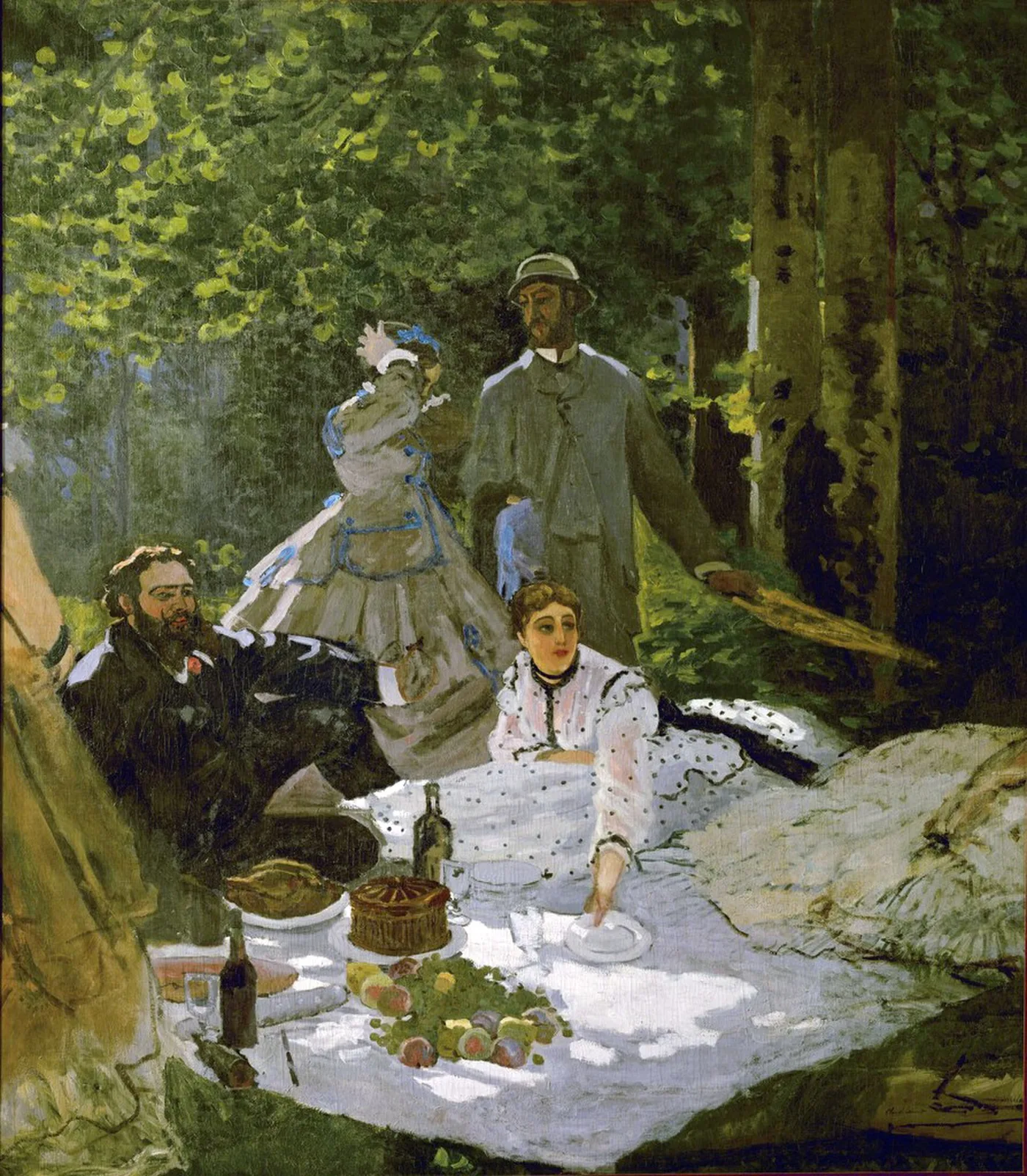
Image: Musée d'Orsay, via Wikimedia Commons.
- Date
- 1865-1866 (unfinished; cut up by Monet in 1884)
- Medium
- Oil on canvas
- Dimensions
- Left fragment 418 x 150 cm; central fragment about 248 x 218 cm
- Location
- Painted at Chailly-en-Bière, on the edge of the forest of Fontainebleau; models included Frédéric Bazille and Camille Doncieux
- Collection
- Musée d'Orsay, Paris: left fragment RF 1957 7 (gift, 1957); central fragment RF 1987 12 (accepted in lieu of tax, 1987)
- Also known as
- Le Déjeuner sur l'herbe (Monet); Monet's Déjeuner sur l'herbe; Luncheon on the Grass (fragments)
What survives and what it shows
Monet's Luncheon on the Grass no longer exists as a single painting. What survives in the Musée d'Orsay are two large pieces cut from it: a tall, narrow left fragment more than four meters high, and a central fragment about 2.5 by 2.2 meters. A smaller, complete version of the composition, now in the Pushkin Museum in Moscow, shows what the whole picture was meant to look like.
The scene is a picnic in a forest glade. Twelve men and women in the fashionable Paris clothes of the 1860s gather around a white cloth spread on the ground with fruit, cakes and wine. Some sit and some stand. Above them a large tree filters the sunlight, scattering patches of light and shade over the figures and the cloth. The central fragment includes a man seated at left, identified as the painter Gustave Courbet, near Camille Doncieux, and Bazille standing beside a woman arranging her hair.
Monet's answer to Manet
The title deliberately echoes Édouard Manet's Le Déjeuner sur l'herbe of 1863, the painting of a nude woman picnicking with two clothed men that caused a scandal at the Salon des Refusés. Manet's canvas, also now in the Musée d'Orsay, measures about 208 by 265 centimeters.
Monet's version is both larger and quite different in spirit. There is no nude and no reference to old master pictures. Instead, he set out to paint an entirely contemporary scene: ordinary well-dressed people on an outing in the country, at life size, under real outdoor light. Art historians have contrasted Manet's flat, studio-like lighting with Monet's attempt to capture the sparkle of sunlight through leaves. Some scholars read the project as a homage to Manet, others as a challenge to him. Either way, Monet, then in his mid-twenties, was attempting a canvas on the scale of a history painting, but with a modern subject.
How it was made at Chailly
In spring 1865 Monet went to Chailly-en-Bière, a village on the edge of the forest of Fontainebleau, to make outdoor studies for the picture. He asked his friend Frédéric Bazille to pose, and Bazille appears several times in the composition, in different poses and clothes. Camille Doncieux, later Monet's wife, also modeled.
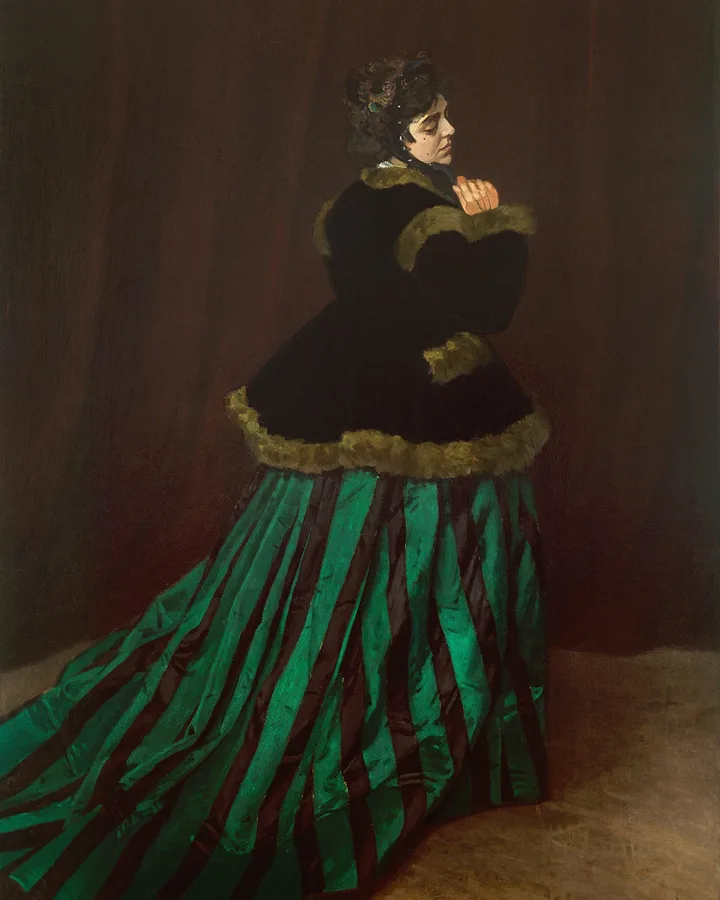
Work was interrupted when Monet hurt his leg and was confined to bed; Bazille recorded the episode in his painting The Improvised Field Hospital (1865). Monet planned to send the finished canvas to the Salon of 1866, but he had underestimated how long it would take to transfer his studies to such a large surface, and it was not ready. At that Salon he was represented instead by a portrait of Camille, known as Woman in the Green Dress, which was a success. Visitors to his studio, including Courbet and Eugène Boudin, saw the unfinished Luncheon, but Monet eventually rolled up the canvas and abandoned it.
Damp, debt and a pair of scissors
The painting's later history explains why it survives only in pieces. Short of money, Monet left the canvas with his landlord in 1878 as security for unpaid rent. When he recovered it in 1884, it had been stored in damp conditions and parts of it had rotted. The French national collections record states that Monet himself cut it up in 1884, keeping the pieces that were still in good condition. The rest of the canvas did not survive.
The surviving fragments stayed in the family and passed to Monet's son Michel. The central fragment was trimmed again on its right side after 1920. Both pieces were later sold to private collectors. The left fragment was given to the French state in 1957, and the central fragment entered the national collections in 1987 through the dation system, under which works of art can be accepted in payment of tax. The two pieces were reunited at the Musée d'Orsay.
What to look for
In the central fragment, look at the white tablecloth. It is the brightest area of the picture and acts as a stage for a small still life of food and bottles, with a knife and a bottle in the foreground helping to set up the perspective. Monet used a light-toned ground under the paint to keep the colors luminous.
Compare the women's dresses with the men's suits. The dresses are carefully worked, with strong contrasts of light and shade and, on the seated woman's bodice, a faint pink that suggests thin fabric. The men are painted in broader, darker, flatter tones.
In the tall left fragment, notice how the dappled light falls on the figures standing under the trees. One writer has described the bright accents on a dress there as a visual siren cutting through the harmony of the scene. Comparing both pieces with the Moscow version helps you place them: the left fragment was the far left edge of the party, the central fragment its heart.
Frequently asked questions
Where is Monet's Luncheon on the Grass?
Two surviving fragments are in the Musée d'Orsay in Paris (RF 1957 7 and RF 1987 12). A smaller complete version of the composition, dated 1866, is in the Pushkin Museum of Fine Arts in Moscow.
Why was Monet's Luncheon on the Grass cut up?
Monet left the unfinished canvas with his landlord in 1878 as security for rent. When he got it back in 1884, damp had damaged it, so he cut it up and kept the parts that were still sound.
What is the difference between Monet's and Manet's Déjeuner sur l'herbe?
Manet's 1863 painting shows a nude woman with two clothed men and caused a scandal. Monet's version, begun in 1865, has no nude: it shows a large group of fashionably dressed people picnicking in a forest, painted to capture natural outdoor light. Both are now in the Musée d'Orsay.
Who are the people in Monet's Luncheon on the Grass?
Frédéric Bazille posed for several of the men and Camille Doncieux for some of the women. The seated bearded man in the central fragment is identified as Gustave Courbet.
Sources
- Le déjeuner sur l'herbe, left fragment, Joconde record 000PE003969 (French Ministry of Culture, POP)
- Le Déjeuner sur l'herbe (Monet, Paris) (Wikipedia)
- Le Déjeuner sur l'herbe (Monet) (Wikipédia, French)
- Le Déjeuner sur l'herbe (Monet, Moscow) (Wikipedia)
- Manet, Le déjeuner sur l'herbe, Joconde record 000PE003916 (French Ministry of Culture, POP)