The Japanese Footbridge (1899)
An arched wooden footbridge crosses Monet's water lily pond at Giverny, framed by dense green foliage and floating lily pads. This canvas, now in the National Gallery of Art in Washington, is one of twelve views of the bridge and pond that Monet painted in the summer of 1899. He returned to the bridge for the rest of his life, ending with near-abstract versions painted around 1920.
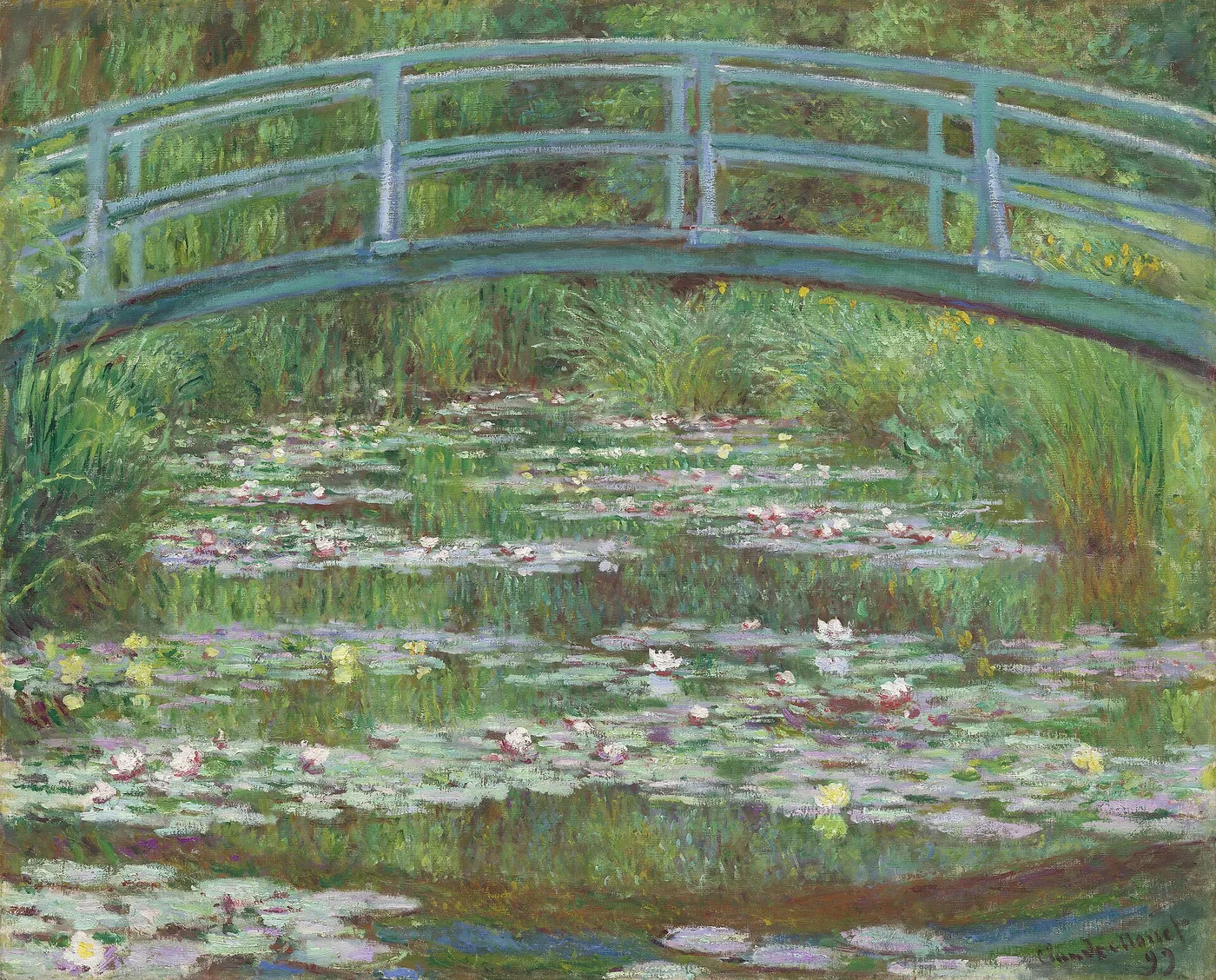
Image: Wikimedia Commons.
- Date
- 1899
- Medium
- Oil on canvas
- Dimensions
- 81.3 x 101.6 cm (32 x 40 in.)
- Collection
- National Gallery of Art, Washington, Gift of Victoria Nebeker Coberly, in memory of her son John W. Mudd, and Walter H. and Leonore Annenberg (1992.9.1)
- Location
- Monet's water garden, Giverny, Normandy
- Signed
- Lower right: Claude Monet / 99
- Series
- One of twelve views of the bridge and pond painted in summer 1899
- Also known as
- The Japanese Footbridge (1899); Japanese Footbridge; Le Pont japonais; Bridge over a Pond of Water Lilies
What the painting shows
Monet faces his water garden head on. A wooden footbridge, painted blue-green, arches across the full width of the canvas, its top sitting just below the upper edge. Behind and around it is a wall of trees, shrubs and bankside plants in many shades of green, which close off the view completely, so there is no sky. Below, the pond is covered with floating water lilies, touched with white and pink, and the spaces between them reflect the greenery and the light.
The composition is simple and almost symmetrical, but the surface is busy. Lily pads are laid in as short horizontal strokes that get smaller as they recede, giving the pond depth, while the foliage behind is built up in thicker, more vertical touches. The National Gallery compares the enclosed effect to medieval images of the enclosed garden, a private, dreamlike space for contemplation.
Monet's water garden at Giverny
Monet moved to Giverny in 1883 and bought his house there in 1890. In February 1893 he acquired a marshy plot across the railway line at the south end of the property and asked permission to divert water from a branch of the Epte river to make a pond. Despite local objections, he had the permits by July, and within a few months the pond and a Japanese-inspired wooden bridge were finished.
Monet designed the water garden himself, choosing the shape of the pond, the water lilies and the plantings around it. He told the authorities it would be a pleasure for the eyes, but he also intended it as a source of subjects. The bridge echoes the arched bridges in Japanese woodblock prints, including those of Hiroshige, several of which Monet owned. By May 1901 he had bought more land so that he could enlarge the pond, and building and painting the garden occupied him for much of the rest of his life.
The 1899 series
Monet painted the bridge at least twice in 1895, but he first took up the garden in earnest in the summer of 1899, when he made twelve pictures of the pond, each looking straight at the bridge as it spans the canvas. Most are nearly square and share a cool palette, but he varied the format and cropping. Besides Washington's canvas, the group includes Water-Lily Pond, Symphony in Green in the Musée d'Orsay and Bridge over a Pond of Water Lilies in the Metropolitan Museum of Art. In the summer of 1900 he painted six more views from farther back and to the left, among them the Art Institute of Chicago's Water Lily Pond.
In late 1900 Durand-Ruel showed twenty-six recent works by Monet in Paris, twelve of them of the water lily pond. Critics noted the influence of Japanese art. Gustave Geffroy described the pool as a mysterious mirror ringed by drooping greenery, while Charles Saunier complained of a lack of variety in the viewpoints.
Where this canvas has been
The Washington picture left Monet's studio almost at once. According to the National Gallery's provenance, the dealer Durand-Ruel bought it from the artist in January 1900. In 1920 it was sold to the Carnegie Institute in Pittsburgh, and in 1953 it went to the New York dealer Sam Salz, who sold it to Henry T. Mudd of Los Angeles. It passed by inheritance to his wife, Victoria Nebeker Coberly, and came to the National Gallery of Art from her estate in 1992, given in memory of her son John W. Mudd together with a gift from Walter H. and Leonore Annenberg.
The canvas is signed and dated at lower right, Claude Monet / 99, and carries the accession number 1992.9.1. It should not be confused with Bridge over a Pond of Water Lilies at the Met, a taller, upright canvas from the same 1899 group, or with the later Japanese Footbridge at the Museum of Modern Art. Washington's version is the wide horizontal one, with the arch spanning the full width of the picture.
The later footbridge paintings
The bridge stayed with Monet for the rest of his life, but it changed. From about 1918 into the early 1920s he painted it again many times. These late versions, such as the Japanese Footbridge of about 1920 to 1922 in the Museum of Modern Art in New York, which MoMA describes as among his last paintings of the subject, look very different from the 1899 series. The arch is almost lost in thick, tangled strokes of reds, yellows and greens, and the image comes close to abstraction.
The change is often linked to Monet's eyesight. Cataracts were diagnosed in both eyes in 1912, and by around 1918 he found that reds looked muddy and subtle colors were lost to him. He had surgery on his right eye in 1923. Writers still debate whether the late bridges record his failing vision, a deliberate new freedom, or both. Placed beside the Washington canvas, they show how far Monet travelled with a single motif.
What to look for
Look first at the bridge. It is not painted as a solid object with a clear structure but as a band of blue-green strokes, slightly broken, that floats in front of the foliage. Then look at the lilies: they are horizontal dabs, wider at the bottom of the canvas and smaller near the bridge, which is almost the only perspective cue in the picture.
Notice the absence of sky. By filling the top of the canvas with leaves, Monet makes the garden feel closed and quiet, and pushes all the light into the water. Watch how reflections of the greenery mix with the lily pads, so that you cannot always tell what floats on the surface and what is reflected in it. That ambiguity, between the real surface and its mirror image, became the main subject of his Water Lilies paintings over the next quarter century.
Frequently asked questions
Where is Monet's The Japanese Footbridge?
This 1899 canvas is in the National Gallery of Art in Washington, accession number 1992.9.1. Other versions of the bridge are in the Musée d'Orsay, the Metropolitan Museum of Art, the Art Institute of Chicago and the Museum of Modern Art, among others.
How many Japanese bridge paintings did Monet make?
He painted the bridge at least twice in 1895, twelve times in the summer of 1899 and six more times in 1900, and returned to it many times again between about 1918 and the early 1920s.
When did Monet build the Japanese bridge at Giverny?
He bought the land for the water garden in February 1893 and received permits to divert water for the pond that July. The pond and its Japanese-inspired wooden bridge were completed within a few months.
Why do Monet's later Japanese bridge paintings look so different?
In the late versions, painted around 1918 to 1922, the bridge dissolves into thick strokes of red, orange and green. Monet had cataracts, diagnosed in 1912, which affected how he saw color, and he had surgery in 1923. Many writers also see a deliberate move toward greater freedom in these works.
Sources
- The Japanese Footbridge, 1899 (National Gallery of Art on Google Arts & Culture)
- National Gallery of Art open data, objects.csv (record 74796, 1992.9.1)
- Cat. 37, Water Lily Pond, 1900, in Monet Paintings and Drawings at the Art Institute of Chicago
- Painting with impaired vision: Claude Monet (The Eclectic Light Company)