The Cliff Walk at Pourville (1882)
Two women stand on a grassy cliff top in the wind, looking out over a bright blue Channel scattered with sailing boats. Monet painted it in 1882 near Pourville, on the Normandy coast west of Dieppe, during a year in which he made nearly a hundred coastal pictures. It is in the Art Institute of Chicago.
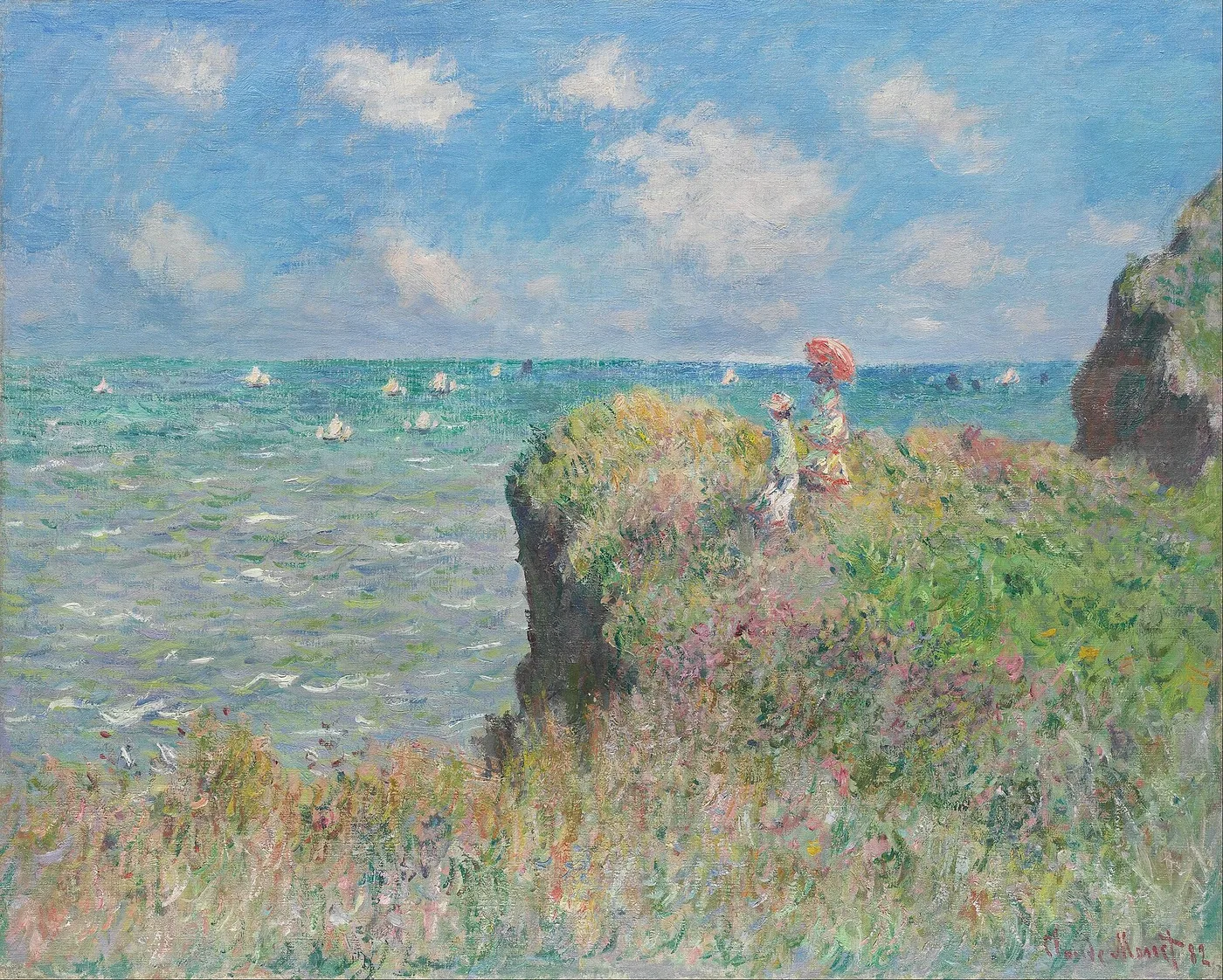
Image: Art Institute of Chicago, via Wikimedia Commons.
- Date
- 1882
- Medium
- Oil on canvas
- Dimensions
- 66.5 x 82.3 cm (26 1/8 x 32 7/16 in.)
- Collection
- The Art Institute of Chicago, Mr. and Mrs. Lewis Larned Coburn Memorial Collection (1933.443)
- Location
- Cliffs near Pourville, probably at Val Saint-Nicolas between Pourville and Dieppe, Normandy
- Signed
- Lower right: Claude Monet 82
- Also known as
- Cliff Walk at Pourville; Promenade sur la falaise, Pourville; The Walk on the Cliffs
What the painting shows
We stand on a cliff top covered in rough grass and wildflowers. Near the edge, two women in summer dresses and shawls look out to sea. Beyond them two lobes of land jut out into the water, their rocky faces in deep shadow. The sea below is an intense blue, dotted with small sailing boats, and above it a bright summer sky holds a few white clouds.
The picture is built from three zones, land, water and sky, and the bottom left corner is filled with a slope of grass that runs diagonally up toward the figures. Everything seems to move in the wind: the grass is made of short, brisk, curved strokes, and subtly varied versions of the same strokes describe the women's wind-whipped skirts and the ripple of the sea. The figures are not set apart from the landscape but woven into it.
Monet on the Normandy coast in 1882
In February 1882 Monet went to Normandy to paint, one of many such trips he made in the 1880s. It was also a retreat. His wife Camille had died in 1879, and he was now living with Alice Hoschedé, the wife of his former patron Ernest Hoschedé, and their combined children. France was in an economic slump that hurt his sales, and he was unenthusiastic about the seventh Impressionist exhibition, leaving his contribution to his dealer, Paul Durand-Ruel.
Monet found the area around Dieppe too urban and settled at Pourville, a fishing village a few kilometers west, where he stayed until mid-April. He wrote to Alice and the children about how beautiful the countryside was becoming and how much he wanted to show them its corners. In June the family joined him for a second stay that lasted until early October. That year he painted nearly a hundred canvases along this coast.
Who are the two women?
The two figures are usually identified with Monet's new household. The Art Institute's collection entry calls them probably Marthe and Blanche, the two eldest Hoschedé daughters. The museum's scholarly catalogue is more cautious: they are often thought to be Alice Hoschedé and one of her daughters, or perhaps Marthe and Blanche. Blanche later became a painter herself.
The bright summer light and the presence of the figures suggest that Monet painted the picture during the second, summer visit, when the family was with him. Monet did not give them faces or detailed costumes. As in Japanese prints, where women appear wrapped in fabric and holding umbrellas, their clothes are relatively illegible and they function as shapes and accents of color, and as a measure of the scale of the cliffs.
A carefully built landscape
Although it looks spontaneous, the picture was not dashed off. During his first 1882 trip Monet told Alice that most of his studies had needed ten or twelve sessions and several of them twenty. X-radiographs show that he reduced the rocky outcrop at far right to balance the proportions of sea and sky.
Monet often painted two to five variations of one motif on these trips, and he was already thinking in series: in March 1882 he told Durand-Ruel he did not want to send new canvases until he could see the series together. A closely related painting, Edge of the Cliff at Pourville, now in a private collection, shows the same site without figures. The art historian Virginia Spate saw such pairs as experiments in what the presence or absence of a spectator changes. The bird's-eye viewpoint, flat planes of contrasting color, cropped edges and winding cliff line also recall the prints of Hokusai and Hiroshige in Monet's own collection.
Picturesque or sublime?
The painting has prompted debate over what it is really about. The art historian Robert L. Herbert noted that only four of Monet's many 1882 coastal pictures include tourists, and all four show two women looking out to sea. He read the figures as intermediaries that make this a vacation picture, with all signs of work and the city removed. Richard Thomson argued instead that Monet was after a modern version of the sublime: the tiny figures on the shadowed crag make us feel the drop and the power of land, sea and sky.
The painting itself holds both readings. Nature is grand but not hostile; sailboats drift on a calm sea under a fine sky. Monet first showed it in his solo exhibition at Durand-Ruel's gallery in March 1883 as Promenade sur la falaise, and it was in London the same year. It reached Chicago through the collector Annie Swan Coburn and came to the Art Institute with her bequest in 1933.
What to look for
Get close to the grass in the lower left. The strokes are short, curved and loaded with color, green, yellow, pink and blue, and they all tilt the same way, so the wind becomes visible. Then look at the women's skirts and see how the same kind of stroke continues into the fabric. It is hard to tell where the grass ends and the dresses begin, which is exactly the point.
Compare the dark, shadowed faces of the two headlands with the sunlit cliff tops above them; Monet uses these sharp contrasts, rather than perspective, to push the land back in space. Count the sails scattered across the water, each a single small stroke of white. Finally, notice how far the horizon is from the figures, and how the diagonal of the slope leads your eye from the corner up to the women and then out to sea.
Frequently asked questions
Where is The Cliff Walk at Pourville?
It is in the Art Institute of Chicago, part of the Mr. and Mrs. Lewis Larned Coburn Memorial Collection, accession number 1933.443.
Who are the women in Cliff Walk at Pourville?
They are usually identified as members of Monet's household: probably Marthe and Blanche Hoschedé, the eldest daughters of Alice Hoschedé, or possibly Alice herself with one of her daughters.
Where is Pourville?
Pourville is a small seaside village on the Normandy coast just west of Dieppe. Monet stayed there twice in 1882 and painted the cliffs and beaches many times.
When did Monet paint Cliff Walk at Pourville?
In 1882. The bright summer light and the presence of the figures suggest it dates from his second stay, from mid-June to early October, when Alice Hoschedé and the children were with him.